
A Digital Product Passport (DPP) can cost anywhere from €2,500 to more than €100,000 a year, depending on the size of the business, number of products, supplier network and level of data required.
For a small brand, a basic DPP programme can cost €2,500–€10,000 in the first year. A mid-sized fashion or textile company may spend €10,000–€50,000 a year. Large companies with multiple brands, thousands of products and complex supply chains can spend €100,000 or more.
The software is only one part of the cost. Collecting product and supplier data, calculating environmental impacts, integrating existing systems and setting up the passports can make up a large part of the budget.
Digital Product Passport cost at a glance
| Business size | Typical first-year cost | Ongoing annual cost |
| Small brand, under 100 SKUs | €2,500–€10,000 | €1,000–€5,000 |
| 100–1,000 SKUs | €10,000–€40,000 | €8,000–€30,000 |
| 1,000–5,000 SKUs | €40,000–€120,000 | €30,000–€90,000 |
| Multi-brand enterprise | €100,000+ | €80,000+ |
These are planning ranges rather than fixed market rates. Published DPP prices vary considerably, and many providers quote based on the customer’s products, suppliers and integrations.
What does a Digital Product Passport include?
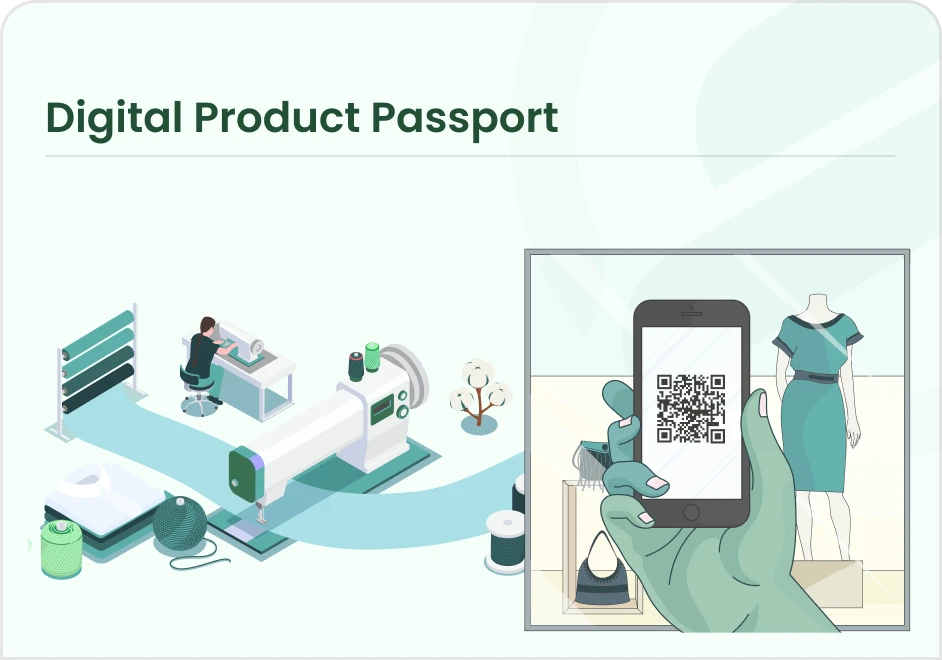
A DPP is a digital record linked to a specific product. While the textile specific law isn’t out yet, it can contain information such as:
- Product composition
- Material and component information
- Manufacturing and supply chain information
- Environmental information
- Certifications
- Repair information
- End-of-life and recycling information
The record is accessed through a data carrier such as a QR code or NFC tag.
The QR code is inexpensive. Most of the cost comes from collecting, checking, calculating and maintaining the information behind it. That is why the cost of a DPP programme is much higher than the cost of generating a QR code.
What are you paying for?
A DPP programme normally has several cost components.
| Cost | What it covers | Typical cost |
| DPP software | Hosting, passport creation, users and data management | €30–€6,250/month |
| Product footprint | Carbon footprint or LCA for products | €1–€10/SKU for automated calculations; much more for consultancy |
| Supplier data | Collecting information from factories, mills and other suppliers | Usually quote-based |
| Integration | Connecting DPP software with PLM, ERP, PIM and other systems | Usually quote-based |
| Setup and onboarding | Configuration, training and initial data collection | Often 15–25% of annual fee |
| Data carrier | QR, NFC or RFID | QR on an existing label can be close to zero; NFC/RFID can cost more |
| Ongoing hosting | Keeping passports available and updated | Around €0.50–€2 per product/year |
The exact combination depends on what a company already has. A brand with an existing LCA programme and clean supplier data will have a lower implementation cost from one starting from scratch.
How much does DPP software cost?
DPP software is available at several price points.
Some providers publish their prices. Others only provide a quote after reviewing the company’s products and supply chain.
Examples of published pricing in 2026 include:
| Provider | Published price |
| DPP-Tool | From about €29/month |
| Tappr | About €520/month entry; €2,500/month mid-tier; €6,250/month enterprise |
| dpp.cloud | €3,000–€5,000 setup plus €7,000–€12,000/year, with additional product fees |
| Renoon | Under €15,000/year for basic plans; €15,000–€100,000 for premium; €100,000+ for enterprise |
These prices are not directly comparable. A €29/month self-service product and a €100,000 enterprise programme do not provide the same services.
Some low-cost tools focus mainly on creating and hosting the digital passport. Larger programmes can include supplier data collection, traceability, LCA, integrations, compliance support and other services.
How much does a DPP cost per product?
A basic digital passport can cost around €0.50–€2 per product per year for hosting and serving the passport.
That is the cost of the digital record and does not include the work required to collect and prepare the information inside it.
It’s important to understand that while comparing offers because one provider may quote a low per-product fee and charge separately for implementation and data collection. Another may include those services in a larger annual fee.
What factors affect DPP pricing?
Seven factors have an impact on the cost of a DPP programme.
1. Number of products
The number of products covered by the programme affects the number of passport records, the amount of product data to manage and, in some pricing models, the software fee.
The structure of the catalogue also matters. The cost of managing 1,000 distinct products can differ from managing 1,000 SKUs that include multiple variants of the same product.
2. Number of suppliers
Supplier coverage affects both the amount of information that needs to be collected and the work required to collect it.
A programme covering a small supplier base is easier to manage than one involving a large number of factories, mills and upstream suppliers across several countries.
3. Supply chain complexity
The number of supplier tiers involved affects the availability and quality of the information required for a DPP.
Information from direct manufacturing suppliers is generally easier to obtain than information from upstream suppliers. A textile product may require information from several stages of production, including fibre, spinning, weaving or knitting, dyeing, finishing and garment manufacturing.
4. Existing product data
The starting point of the data programme has a direct effect on cost.
Companies with structured product information, established supplier records or existing LCA and traceability programmes have less work to do than companies whose information is spread across spreadsheets, documents and separate systems.
5. Data quality
Industry-average data is cheaper and faster to use.
Primary data collected directly from suppliers takes more work, but gives you more specific information about your products and supply chain.
6. System integrations
The systems that need to exchange data with the DPP platform also affect implementation costs.
A company can upload product information manually or through a file. It can also connect its DPP platform to systems such as a PLM, ERP or PIM. The second approach usually requires more implementation work.
7. Passport level
A passport can be associated with a product model, production batch or individual item.
Model-level passports require fewer records than item-level passports. Item-level passports also require serialisation and, in some cases, changes to production and labelling processes.
Ask every DPP provider which level their price is based on.
DPP cost for small brands
A small fashion or textile brand with fewer than 100 SKUs and a relatively simple supply chain can expect to spend around €2,500–€10,000 in the first year.
The cost can fall in later years once the platform is configured and the initial supplier onboarding is complete. Usually, for small brands, how much data already exists and how many suppliers need to be contacted dictates the cost.
For example, a brand with 50 products from five suppliers will be a much smaller project than a brand with 50 products sourced from 40 suppliers.
DPP cost for mid-sized brands
A company with 100–1,000 SKUs can expect a first-year budget of around €10,000–€40,000. The cost rises with supplier numbers, product complexity and integrations.
For companies with 1,000–5,000 SKUs and multi-tier supply chains, a budget of €40,000–€120,000 is a reasonable planning range. There are no standard pricing ranges. These figures are useful for budgeting before requesting vendor proposals.
DPP cost for large enterprises
Large fashion groups can spend €100,000 or more per year on a DPP programme.
At this level, the project may cover several brands, markets, thousands of products, multiple supplier tiers and integrations with existing enterprise systems. The number of suppliers and systems involved can have as much influence on the final price as the number of products.
Published enterprise pricing in the market already reaches around €6,250 per month before additional product, implementation or integration costs.
What does DPP implementation cost?
Implementation can include:
- Connecting the DPP platform to existing systems
- Setting up product and supplier data structures
- Importing existing data
- Configuring passport templates
- Setting up user access
- Training teams
- Onboarding suppliers
- Testing the first passports
- Setting up the data carrier
Some providers include these services in their subscription. Others charge separately.
A common planning figure is 15–25% of the annual software fee for setup and onboarding in the first year, although enterprise implementations can be considerably higher.
What about QR codes, NFC and RFID?
The physical data carrier is usually a small part of the overall DPP budget. A QR code added to an existing label can have little or no additional cost. NFC and RFID tags cost more, depending on the technology and how they are used. The versions reviewed for this blog put NFC/RFID costs at roughly €0.05–€3 per item.
You should make sure that your existing production and labelling process can accommodate the identifier you’re selecting.
Should you build your own DPP or buy software?
The full DPP system needs data storage, identifiers, access controls, APIs, data management, supplier workflows and the ability to keep the system aligned with changing regulatory requirements.
We estimate that an in-house build can cost approximately €80,000–€250,000 before ongoing maintenance. An in-house system may make sense for a very large company that already has a substantial technology team and specific requirements that existing platforms cannot meet. But, for most brands, buying a platform is likely to be less expensive than building and maintaining the entire system internally.
Does having an LCA reduce DPP costs?
Yes. A product LCA already requires many of the material and process data points that can be used for a DPP.
If you already have reliable product and supplier data, you’ll need to do less work. The same applies to existing traceability programmes. Reusing data reduces duplicate supplier requests and implementation work.
It is one of the reasons why some platforms combine DPP, LCA, traceability and ESG data.
Questions to ask a DPP provider before comparing prices
Ask each provider:
- Is the price per SKU, batch or physical item?
- How many suppliers are included?
- Is supplier data collection included?
- Is product LCA included?
- Are integrations with PLM, ERP or PIM systems included?
- Are setup and onboarding included?
- Is there a separate fee for every passport or activation?
- Are QR, NFC or RFID costs included?
- How long are passports hosted?
- What happens to your data and passports if you end the contract?
- Are regulatory updates included?
- Can the same product and supplier data be used for LCA, traceability and ESG reporting?
These questions make it easier to compare the total programme cost rather than just the software subscription.
How GreenStitch approaches DPP pricing
GreenStitch does not use a single public DPP price because the cost of a DPP programme depends heavily on the supply chain behind the products.
Our pricing takes into account:
- Product and SKU volume
- Product and material complexity
- Supplier count and supply chain tiers
- Existing data and data quality
- Supplier data collection requirements
- Product LCA requirements
- System integrations
- Other GreenStitch modules used alongside DPP
Supplier and product data once collected can support DPPs, product LCA, carbon accounting, traceability and ESG reporting. This reduces the need to collect the same information separately for different systems.
GreenStitch also has teams working with manufacturers and suppliers across India, Bangladesh, Vietnam, China and Turkey. Supplier onboarding is part of the programme.
Frequently asked questions
How much does a Digital Product Passport cost?
A DPP programme can cost €2,500–€10,000 a year for a small brand, €10,000–€50,000 for a mid-sized company and €100,000 or more for a large enterprise. The final cost depends on products, suppliers, data, integrations and implementation requirements.
How much does a DPP cost per product?
Hosting and serving a digital passport can cost around €0.50–€2 per product per year. This does not include the cost of collecting and preparing the data inside the passport.
What is the biggest cost of a Digital Product Passport?
For fashion and textiles, supplier data collection can be one of the largest costs. The work increases with the number of suppliers, supply chain tiers and countries involved.
Does every product need its own Digital Product Passport?
The required level of identification depends on the relevant product rules. A passport may be associated with a product model, batch or individual item. Always check which level a DPP provider is using when comparing prices.
Does a DPP include product carbon footprint data?
It can. Environmental information is part of the data requirements being developed under the ESPR product rules. Product carbon footprint or LCA work may be included in a DPP platform or purchased separately.
Do companies outside the EU need Digital Product Passports?
Companies selling products covered by EU DPP requirements into the EU market will need to meet the applicable requirements, regardless of where their headquarters are located.
Will DPP costs fall after the first year?
They can. Initial platform setup, supplier onboarding, data preparation and label changes can make the first year more expensive. Once those systems and processes are in place, ongoing costs can be lower.
Should a company build its own DPP software?
For most companies, buying a DPP platform is likely to be more practical than building and maintaining one internally. A build requires ongoing investment in software, integrations, data management and regulatory updates.