
You have probably read at least one explainer on the EU Digital Product Passport if you are a sustainability officer, a product designer, a compliance officer or a sourcing lead at a fashion or textile brand. But, if that article was published before April 2026, there is a good chance the enforcement date it mentions is wrong.
Our earlier guide gave you the foundations of DPP, what it is, why it exists, and how to start preparing. This update builds on that. Since then, three things have happened that have changed the picture.
- The JRC 3rd Milestone (December 2025) published the most detailed technical proposals for the DPP to date, including a brand-new scoring system for product performance.
- The JRC Methodology Report JRC145830 (March 2026) established a formal classification framework for which data fields will be legally mandatory versus recommended.
- The enforcement timeline has been pushed back to mid-to-late 2029, with specific milestones in 2026 and 2027 that demand your attention right now.
Here is everything you need to know in summary, updated for where things actually stand.
This article is the companion of the recently published DPP: Designing for Future Regulation, Now we have produced in partnership with Future Snoops (FS), the leading trend forecast organisation. The report provides the why now, the designer-first argument and the commercial upside; this article digs down into some of the technical and practical topics associated with DPP implementation.
Join us live — 2 July webinar. On 2 July 2026, Future Snoops x GreenStitch will walk through the report’s key insights, with guest presentations from a leading brand and a Tier 1 supplier on what is actually working in their DPP programmes today. Register here to save your seat.
How to read our status markers across the article:
- [LAW] In force now, legally binding, or forecasted to be at some point in the future.
- [POLICY] An official EU position or adopted plan signalling clear intent, but not yet a binding obligation.
- [STUDY] A technical or scientific input (e.g. a JRC Milestone) that shapes the law but creates no obligation by itself.
- [SCENARIO] A planning estimate or projected date, based on the current trajectory and subject to change.
Start your DPP program now
The bottom line for a new Head of DPP: the DPP is no longer a speculative sustainability initiative — the regulatory direction, technical architecture and supply-chain expectations are advanced enough that the question is not whether it happens, but how fast you can operationalise it.
- The EU Digital Product Passport will, from mid-to-late 2029, require every textile product sold in the EU to carry verified, structured data — what it is made of, how durable and recyclable it is, its carbon/ environment footprint, and how to care for and recycle it — accessed by scanning a QR or NFC/ RFID tag. This is not a labelling exercise bolted on at the end: it is one of the most transformative regulatory and business shifts fashion has faced in decades.
- Around 80% of a product’s environmental impact is determined at the design stage, so much of its future DPP outcome — and a large share of its compliance, circularity and commercial value — is locked in there too.
- The supply-chain data you will need takes 12–18 months minimum to assemble (18–24 to do it well at scale) — so the brands that treat the DPP as a strategic platform now, rather than a 2029 compliance scramble, will be the ones that turn it into resale, repair, authentication and customer-engagement revenue.
- DPP is going global: the first China–Europe textile DPP launched in March 2026, US states such as California are advancing textile EPR, and within the EU, France’s Loi AGEC and “Eco-Score”, plus its mature textile EPR system, are already a precursor to the EU regime.
- The single biggest predictor of success is whether you appropriately mobilise design, sourcing, IT and sustainability teams together — starting today.
What to do in your first 90 days
If you read nothing else, do these eight things now. The rest of this article explains why.
- If not yet done, appoint a cross-functional DPP Programme Lead and team with authority across design, sourcing, sustainability, IT, legal and finance. The biggest predictor of DPP failure is treating it as a compliance or IT side-project.
- Run a DPP readiness audit across four dimensions: how DPP-ready your design rules are, what product data you already hold, whether your IT systems (PLM/ ERP/ Sustainability & LCA) can carry it, and how far your supply-chain traceability reaches. Additionally, audit whether your existing LCA data follows the PEF methodology — the DO4 footprint must comply with the EU’s Product Environmental Footprint (PEF) rules for Apparel & Footwear (the EU’s standardised method for calculating and comparing environmental impacts), a methodology gap to close before 2029 if your data isn’t PEF-ready.
- Confirm your unsold-goods position before 19 July 2026, when large enterprises are banned from destroying unsold textiles.
- Audit your consumer-facing green claims before 27 September 2026, when the EU anti-greenwashing law (ECGT) becomes enforceable — 2 years ahead of the DPP itself — and retire any claims you cannot substantiate.
- Bring your design team fully onboard and start embedding DPP requirements into the design process — because most of DPP performance is decided before the first sample is cut.
- Start engaging your Tier 1, 2 and 3 suppliers now. Fabric mills and dye houses (Tier 2) are the binding constraint — but every tier plays a role, and upstream data is the most time-consuming element of the whole programme.
- Run a small end-to-end DPP pilot — not to comply, but to learn where your data breaks while the stakes are low.
- Design your DPP program for business value, not compliance alone: get clear on what the DPP is for in your specific business. Compliance is the floor, identical for everyone selling in the EU — the strategic upside on top differs sharply by where you sit in the market.
The mindset shift: the DPP is not a label you bolt on at the end. It is a data programme that surfaces as a label — and, done right, a growth platform. The brands that understand this in 2026 will not be scrambling in 2029; they will be the ones building for both compliance and commercial value from day one.
First, Let’s Correct the Timeline
Most articles published before April 2026 presented an outdated DPP enforcement date, typically 2027 or early 2028. Based on the current regulatory sequence, the correct timeline is:
| Milestone | Date | Status |
|---|---|---|
| JRC 4th (Final) Milestone | Late 2026 | [STUDY] |
| Textiles Delegated Act — draft proposal | Late 2027 | [POLICY] |
| Textiles Delegated Act — formally adopted as binding EU law | Early-to-Mid 2028 | [POLICY] |
| DPP enforcement begins | Mid-to-Late 2029 | [POLICY] |
All dates beyond mid-2026 are indicative.
The Delegated Act — the document that converts the JRC’s scientific proposals into binding law — was delayed. It is now targeted as a draft in late 2027 [SCENARIO], with formal adoption following a 2–4 month EU scrutiny period in early-to-mid 2028. ESPR mandates a minimum 18-month compliance window from formal adoption — pointing to enforcement from mid-to-late 2029, and potentially early 2030 if Delegated Act adoption slips beyond mid-2028. But the supply-chain work to achieve compliance takes 12–18 months regardless of when the final rules land — the clock is already running.
What the JRC 3rd Milestone Actually Proposes
The JRC 3rd Milestone (December 2025) [STUDY] is the most substantive technical document yet published on textile DPP requirements. It is a scientific study that feeds the Delegated Act directly. It introduces four “Design Options” — the core performance criteria your products will be measured against.
The Four Design Options (DO1–DO4)
DO1 — Robustness Score (0–10)
How durable is a garment after washing?
Products are washed five times, then checked for three things: does the colour hold up, do the seams stay stable, and does the fabric shrink or twist (spirality)? That gives a score out of 10. Most garments today score around 3; best-in-class manufacturing reaches 5. These scores will eventually map to an A–G rating label, much like the one already on washing machines and fridges.
Two things matter most for designers:
- The care label is a legal document, not a suggestion. Tests are run exactly as the label instructs. If the label is wrong, the garment fails, regardless of how well it’s made.
- This score is locked in before manufacturing begins. Fabric weight, stitch density, seam construction and fastener quality are all design decisions — by the time the first garment is cut, the score is essentially set.
DO2 — Recyclability Score (0–10)
How recyclable is your product? This is likely the most commercially disruptive of the four Design Options for fashion.
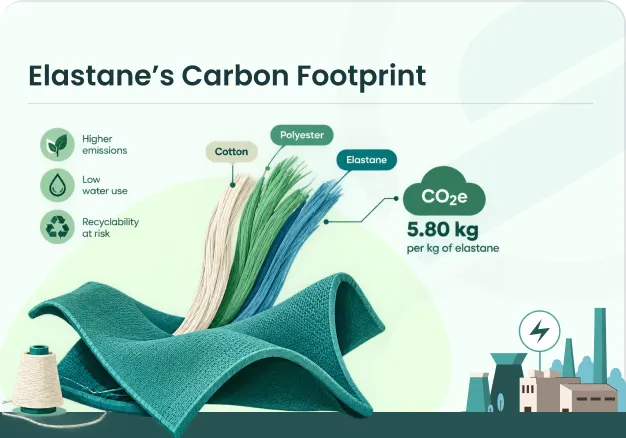
The JRC 3rd Milestone models products with more than 15% elastane content as scoring zero on recyclability; mono-material products score highest. The 15% figure is a modelling assumption that will be confirmed (and updated as recycling technology improves) through future legislation — industry groups are pushing back, but the regulators are clear that excess elastane hurts recyclability and that direction will not reverse.
In practice, designers need to:
- Audit their range now — leggings, swimwear, activewear and stretch denim are most at risk.
- Treat next season’s specs as tomorrow’s problem: locking in a 22% elastane blend now means inheriting a recyclability failure they won’t be able to fix in time.
- Use only as much elastane as they functionally need.
DO3 — Recycled Content (%)
What is the percentage of recycled fibre by weight?
Products will need to declare exactly how much of their fibre content is recycled and where that recycled fibre came from — open-loop sources (like PET bottles) versus closed-loop sources (textile-to-textile recycled fibre). Both source types are accepted through the DPP’s Phase 1; Phase 2 (~2033) is expected to favour closed-loop sources [SCENARIO] — a directional signal, not yet confirmed regulation.
Certification is not optional. There is no lab test that can prove recycled fibre origin after the fact. The claim doesn’t exist without a Global Recycled Standard (GRS) or Recycled Claim Standard (RCS) certificate.
DO4 — Carbon Footprint (CF) or Environmental Footprint (EF)
What is the environmental impact of making this garment?
The JRC proposes two metrics, both restricted to the manufacturing stage:
- DO4.1 — Environmental Footprint: all impact categories in alignment with the EU PEF rules for Apparel & Footwear through a single-score assessment (the stronger long-term option).
- DO4.2 — Carbon Footprint: climate emissions only (easier and cheaper to implement initially).
In DPP’s Phase 1, DO4 environmental footprint disclosure is expected to be mandatory — but brands without primary factory data can use industry-average secondary datasets initially [STUDY]. Products using verified primary data are expected to qualify for higher-tier labelling. This ‘average-data loophole’ is widely expected to close around 2033 [SCENARIO], making primary data collection a priority now.
The New Data Classification Framework: JRC145830
In March 2026, the Commission published a second critical document — JRC Technical Report JRC145830 [STUDY], the cross-sectoral methodology defining how DPP data requirements are identified and classified under all ESPR delegated acts. It establishes three things:
1. A mandatory three-tier data classification
Every DPP data field will be classified as Essential (legally mandatory from day one of enforcement), Strongly Recommended (high value, likely to drive EPR eco-modulation savings; smart to collect now), or Voluntary (strategic differentiators only). The JRC 4th Milestone will apply this classification to all of the 3rd Milestone’s proposed fields; final categories will not be known until late 2026. Based on the classification criteria, the most likely outcome (subject to the 4th Milestone’s confirmation) is:
| Data Field | Likely Classification | Likely Granularity Level |
|---|---|---|
| Unique product identifier (in EU DPP Registry) | Essential | Model / item |
| Fibre composition (incl. recycled content type, microfibre type) | Essential | Model level |
| DO2 Recyclability score | Essential | Model level |
| DO1 Robustness / Durability score | Essential | Model level |
| Hazardous substances / Substances of Concern (SoC) | Essential | Model or Batch level |
| Recycled content % (DO3) | Essential | Batch level |
| Care, repair & end-of-life information | Essential / Strongly Recommended | Model level |
| Environmental footprint (DO4, simplified CF/EF) | Strongly Recommended | Model level |
| Supply chain traceability (key processing stages) | Strongly Recommended | Batch level |
| Qualitative microfibre-release risk | Recommended (Phase 1) | Model level |
| Social fields (living wage, SA8000 audit outcomes) | Voluntary in Phase 1 | Phase 2+ |
2. Three formal granularity levels
- Model-level data (design, fibre composition, recyclability class, care instructions) is the same for all units and comes from the design room.
- Batch-level data (recycled content %, substance test results, country of production) varies per production run and requires live supplier data flows from mills.
- Item-level data (repair history, resale provenance) is unique per physical unit and is reserved for Phase 2+ (~post-2033).
Recycled content % (DO3) is likely to be batch-level, not model-level. Different yarn lots across production runs may carry different certified recycled percentages — a materially harder data infrastructure challenge than recording a design specification once.
3. A formal need-to-know access framework
Not all DPP data is publicly visible:
- Public access: for anyone including consumers; covers fibre composition, recyclability rating, care instructions and carbon/ GHG footprint.
- Supply chain restricted access: for verified value-chain actors (recyclers, repairers); also covers processing chemical identities and mill location detail.
- Regulator-only access: also covers substance-of-concern test data and compliance certificates.
Commercially sensitive process chemistry and facility locations can remain access-controlled even while your brand’s public DPP is visible to consumers — which is your strongest lever to unlock Tier 2 data sharing that mills have resisted on confidentiality grounds.
One open question to watch: who verifies DPP data? The Delegated Act will determine whether brands self-declare (with regulatory liability for errors) or face third-party verification requirements. Under ESPR Article 27, the Economic Operator bears strict liability for DPP accuracy regardless of where the error originated — including supplier misreporting or platform failures. Design your data governance accordingly.
Engage all your Tier 1/ 2/ 3/ 4 suppliers — but know that Tier 2 is the constraint
DPP compliance is a whole-supply-chain effort — start Tier 1/ 2/ 3/ 4 suppliers onboarding immediately, because upstream traceability is the most time-consuming element of the entire programme.
Every tier has a role: Tier 1 (assembly) facilitates robustness testing and assembly-stage chemical data; Tier 2 (mills, dye houses) holds the core composition, treatment and footprint data; Tier 3 (spinners) certifies yarn-level recycled content; and Tier 4 (raw materials, chemicals) supplies origin and substance documentation. A gap at any tier becomes a gap in the passport — but the binding constraint sits at Tier 2:
| Tier | Who | Accessibility | Lead time |
|---|---|---|---|
| Tier 0 | Brand / retailer (legally responsible for every DPP) | — | Start now |
| Tier 1 | CMT / assembly factories | High — existing relationships | 3–6 months |
| Tier 2 | Fabric mills, dye houses | Very low — most brands have no direct data today | 12–18 months |
| Tier 3 | Yarn spinners, fibre processors | Very low — no direct relationship | Very long |
| Tier 4 | Raw materials, chemicals, ginners (EUDR applies to leather via cattle from 30 Dec 2026 — not cotton, which is outside EUDR scope) | Very low — no direct relationship | Longest |
Tier 2 holds roughly 36% of manufacturing-stage GHG emissions (Quantis, 2018) and over half of supply-chain emissions overall (Fashion for Good) — plus the most commercially sensitive data (dye recipes, process chemistry, facility energy use) which mills resist sharing. The JRC145830 access framework (supply-chain restricted, not public) is your strongest unlock. Your multi-tier data programme must start no later than Q4 2026, with all tiers engaged in parallel.
Two practical realities decide whether this works:
- First, supplier engagement cannot run on compliance pressure alone — mills already field overlapping data requests across DPP, CSRD and traceability, and in most pilots the most common response was not “no” but “why?”. Budget 3–6 months of supplier education and show suppliers the commercial value of higher-quality data.
- Second, watch the China–Europe pilots: they are the first real-world test of capturing Tier 3 and Tier 4 data at scale.
What breaks in real pilots — lessons from early DPP programmes
- Serialisation mistakes: teams generate one QR at batch level when item-level serialisation was needed (or vice-versa) — cheap to fix in a pilot, very expensive in production.
- Physical carrier constraints: a QR printed on a care label becomes unreadable once the garment is folded or worn; hangtags scan well in-store but get removed. Decide carrier placement early.
- The supplier “why?” problem: mills asked for batch-level data for the first time respond with confusion, not refusal — budget months of education before data flows.
- Internal alignment: executive sign-off isn’t enough; named ambassadors in design, sourcing and IT are what actually move the programme.
What the 3-Phase Rollout Actually Looks Like Now
Our original guide described three phases. The phases are still correct in concept, but the timings have changed, and the content of Phase 1 is now significantly more specific.
| Phase | Indicative Start | DPP Maturity | Key Requirements (summary) |
|---|---|---|---|
| Phase 1 | ~Mid-to-Late 2029 [POLICY] | Minimal DPP | DO1–DO4 scores; fibre composition; substances of concern; qualitative microfibre risk; care instructions and end-of-life handling; voluntary repair info; Tier 1 supplier traceability; unique ID in the EU DPP Registry; QR/RFID/NFC carrier. |
| Phase 2 | ~2033 [SCENARIO] | Advanced DPP | Primary product-specific LCA; full Tier 2 traceability; quantitative microfibre rate (pending ISO/TC 38); social & due-diligence fields; DO4 average-data loophole closes; repairability likely scored. |
| Phase 3 | ~2036 [SCENARIO] | Full Circular DPP | Full EU-ecosystem interoperability; real-time lifecycle tracking; cross-border data exchange; the DPP as the backbone of a circular textile economy. |
These are planning estimates. Timelines and scope are subject to the Delegated Act.
2026–27: What You Cannot Ignore — Deadlines, Reports & Standardsbuilt-in DPP and lifecycle assessment (LCA) module
The DPP enforcement date may be 2029, but several legally binding milestones land sooner — five in 2026–27 — alongside a handful of non-binding milestones (a JRC study, harmonised standards) that will firm up what Phase 1 actually requires. Both sets matter.
The legally binding deadlines
31 May 2026 [LAW] — REACH ECHA Microplastics Emission Report. First annual report due to ECHA for manufacturers and industrial users of synthetic polymer microparticles (SPM) as pellets, flakes or powders (REACH Annex XVII Entry 78). This primarily applies to upstream synthetic-feedstock handlers (Tier 4), not brand operations or Tier 2 mills — but verify with your synthetic-fibre suppliers. Distinct from the plastic-pellet-loss rules below.
19 July 2026 [LAW] — Unsold Goods Destruction Ban. Large enterprises are prohibited from destroying unsold apparel, accessories and footwear from this date. Large brands must also disclose volumes destroyed during the most recent prior financial year, and the reasons (“safety”, “damage”, “unsold stock”) — the data is public, so “unsold stock” as a primary reason carries reputational exposure. Medium-sized enterprises follow from 19 July 2030; micro and small businesses are exempt.
Mid 2026 [LAW] — EU DPP Registry Go-Live. ESPR Art. 12 requires the EU Commission to launch the EU DPP Registry by mid-July 2026. Brands’ legal obligation to register textile products arises only after the Delegated Act is adopted (expected early-to-mid 2028). But mid-2026 is the right moment to begin voluntary pilot registrations, validate IT integration, and confirm your DPP service provider’s Registry compatibility.
27 September 2026 [LAW] — ECGT Anti-Greenwashing Enforcement. The Empowering Consumers for the Green Transition Directive (ECGT, Directive (EU) 2024/825) applies from this date — prohibiting unsubstantiated generic environmental claims (“eco-friendly”, “green”, “conscious”, “sustainable”) and banning offset-based “climate neutral” product labels. From this date, competitors, NGOs and consumers can legally challenge unverified claims through national courts — years before the DPP itself. Audit all consumer-facing sustainability claims now.
17 December 2027 [LAW] — Plastic Pellet-Loss Rules. Regulation (EU) 2025/2365 (in force since 16 December 2025) targets microplastic pellet losses across the supply chain. Its main operational obligations — loss prevention, notification, and certification for handlers above 1,500 tonnes/year — apply from 17 December 2027. It primarily hits Tier 4 polymer producers and some Tier 2 mills, not brand-owned operations — but verify with your synthetic-fibre suppliers.
The non-binding milestones that will firm up Phase 1
Today’s Phase 1 picture is built on a study, not final law. Four events between now and 2027 will turn proposals into confirmed requirements:
JRC 4th (Final) Milestone (late 2026, [STUDY]). This is the one to watch. The 3rd Milestone went through stakeholder consultation; the 4th Milestone is expected to deliver the final, confirmed set of Phase 1 requirements — which Design Options become mandatory information labels, the A–G grade boundaries, the confirmed data fields and their Essential/Recommended/Voluntary classification, and the treatment of the DO4 “average-data” question. It is the direct input to the Textiles Delegated Act — the moment your data model moves from “plan against the likely” to “build against the confirmed.”
CEN/ CENELEC JTC 24 system standards (rolling, late 2025–2026). The harmonised standards for the DPP system layer (data carrier, unique identifiers, access rights, interoperability — EN 18222/18223 in finalisation) were expected from late 2025 and several are still being finalised as of spring 2026. As they land, they confirm the technical rules your platform must meet — and de-risk the “system layer” buying decision.
Battery DPP becomes mandatory (February 2027). The EU Battery Regulation makes the battery passport the first DPP regime to become legally operational at scale across any sector, well ahead of textiles. The real-world proof-of-concept for the Registry, data carriers and access model — watch what works and what breaks, because textiles will inherit the same architecture.
CIRPASS-2 and other EU pilots (through 2026–27). EU-funded textile DPP pilots continue to test the reference architecture. They are the best public source of practical lessons on data exchange and verification before the rules bind.
The role of AI-enabled DPP and LCA Software
The data demands of the DPP — model-level fields from the design room, batch-level fields from mills per production run, chain-of-custody certification across a five-tier supply chain — cannot be managed in spreadsheets. The JRC145830 model-versus-batch distinction alone requires operational integration with supplier systems that spreadsheets cannot maintain reliably at scale.
When evaluating DPP platforms, prioritise the following key topics. A platform that cannot confirm these five capabilities creates multi-million-euro technical debt when Phase 2 requirements expand. Software is only part of the budget — how much a Digital Product Passport costs depends as much on supplier data, LCA and implementation as on the licence fee.
- GS1 Digital Link support for unique product identifiers
- EPCIS 2.0 compatibility for supply chain event data
- CEN/ CENELEC JTC24 alignment for EU Registry interoperability
- The ability to handle both model-level and batch-level data flows from the same supplier network
- The ability to evolve and fully align on time with the final regulatory requirements
GreenStitch offers a built-in DPP and lifecycle assessment (LCA) module alongside broader solutions for environmental product declarations (EPDs), carbon accounting and reporting, science-based targets and decarbonisation, and ESG reporting. We build DPP data infrastructure from verified lifecycle and supply-chain data, connecting with existing ERP and PLM systems to pull information directly from Bills of Materials and supplier declarations. As DO1–DO4 scoring, batch-level data collection and EU Registry integration become the reality of compliance, the difference between a DPP built from verified primary data and one populated with industry averages will have direct consequences — on EPR fee bands, on ECGT-compliant claims, and on the integrity of your brand’s sustainability story.

Try our demo DPP QR code yourself
Scan the QR on the left to see a working DPP record built on GreenStitch’s platform — the same data layer that your future passports will need to carry. It is the fastest way to feel what a Phase 1 DPP looks like to a consumer, a recycler and a regulator.
Important Note: this is a demo DPP QR code developed on the basis of current DPP requirements. DPP interfaces will continue to evolve and will ultimately be aligned to final regulatory requirements and the given brand/supplier specific requirements.
Sources
The ESPR Regulation (EU) 2024/1781; the JRC 3rd Milestone for textiles (December 2025); JRC Technical Report JRC145830 on DPP data classification (March 2026); the EU Textile EPR Directive (EU) 2025/1892; and the ECGT Directive (EU) 2024/825. Where something is a proposal rather than law, we flag its status (see the key above). This is a strategic briefing, not legal advice — confirm specifics against the official texts before acting.