
If you are a sustainability officer at a fashion brand or textile manufacturer, you know that the way product and supply-chain information is managed is changing significantly. What was once difficult to trace across multiple tiers of the value chain will increasingly need to be documented, structured, and accessible.
Under the Ecodesign for Sustainable Products Regulation (ESPR), which entered into force on 18 July 2024 in the European Union, the Digital Product Passport (DPP) is a regulatory requirement that will change how product data is collected, verified, and shared. For companies in fashion and textiles, this means building systems that can connect information across the full product lifecycle, from raw material sourcing to manufacturing, distribution, use, and end-of-life.
Textiles have been identified as a priority sector under the regulation because of their significant environmental footprint, rapid production cycles, and low recycling rates. The introduction of DPP will therefore have practical implications for how companies track materials, engage suppliers, manage compliance data, and communicate product information.
What is a Digital Product Passport?
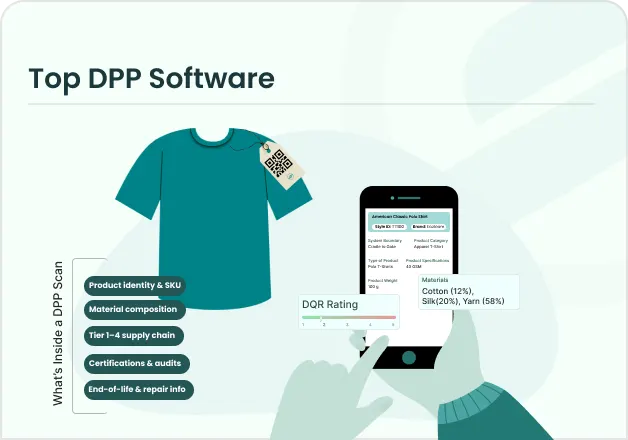
A DPP is a digital record attached to a physical product, reached by scanning a QR code, NFC tag, or RFID chip on the garment. It carries the product’s material composition, its carbon or environmental footprint, care and repair guidance, and where in the supply chain it was made, covering the item’s life from raw material to disposal.
It helps to think of the DPP in three layers:
- The System Layer: The carrier (QR/NFC) and the link to the EU DPP Registry; This is standards-led, built on GS1 Digital Link and CEN/CENELEC JTC 24, and most brands will “buy” rather than “build” it.
- The Data Layer: The actual product information (composition, scores, footprint); This represents 90% of the effort and risk.
- The Customer Experience Layer: Optional for compliance, this covers authentication, aftercare, and resale, turning data into revenue
Addressing the Triple Crisis of Fashion
The textile industry is facing ecological, economic, and social pressure at once. High wastage and fragmented global supply chains make it a major user of non-renewable resources and water.
The textile-specific DPP is aimed directly at the fast-fashion model. By making material longevity and production conditions visible at the point of sale, the EU is betting that transparency shifts demand toward products built to last and to be repaired.
Where the Timeline Actually Stands Now
Most published guidance on DPP timing, including earlier drafts of this post, points to 2027 as the first compliance milestone. That date has changed.
| Milestone | Date |
| JRC 4th (Final) Milestone | Late 2026 |
| Textiles Delegated Act — draft | Late 2027 |
| Textiles Delegated Act — adopted as binding law | Early-to-mid 2028 |
| DPP enforcement begins | Mid-to-late 2029 |
The Delegated Act is the instrument that turns the JRC’s technical proposals into binding rules for textiles, and it has been delayed. Once adopted, ESPR requires a minimum 18-month compliance window before enforcement, which points to enforcement landing sometime between mid and late 2029.
This doesn’t buy anyone more time. Supply-chain data collection, particularly from Tier 2 mills and dye houses, takes 12 to 24 months to do properly. Working back from 2029, a brand that hasn’t started building those data flows by late 2026 is already behind.
A 3-Phase Deployment
The DPP is expected to deepen across three phases. Dates beyond Phase 1 are scenario-based projections from the EU Parliament STOA study, not adopted schedules.
| Phase | Indicative Start | DPP Maturity Level | Requirements |
| 1 | ~2029 | Minimal DPP | DO1–DO4 performance scores; fibre composition; substances of concern; qualitative microfibre-release risk flag; voluntary repair-service information; unique ID in the EU DPP Registry; QR/RFID/NFC carrier on the product |
| 2 | ~2033 | Advanced DPP | Primary product-specific LCA; full Tier 2 traceability; quantitative microfibre shedding rate (pending an ISO/TC 38 standard); social and due-diligence fields; the DO4 “average-data” loophole expected to close; repairability likely to become a scored requirement |
| 3 | ~2036 | Full Circular DPP | Full EU-ecosystem interoperability; real-time lifecycle tracking; cross-border data exchange, readable by any EU recycler, resale platform, or customs authority regardless of which software created it |
A note on sourcing: this is drawn from the JRC’s 3rd Milestone for textiles (December 2025) and JRC145830 (March 2026), both technical inputs to the eventual law, not law themselves. The JRC’s 4th and final milestone, expected late 2026, is what confirms which fields actually become mandatory.
If your brand is based outside the EU, like the U.S., India, wherever, but you sell into the European market, these requirements still apply to you.
What Data Will You Actually Need to Collect?
Phase 1 is built around four Design Options, the performance criteria your products will be scored against:
- DO1 — Robustness – How durable is a garment after washing?
A durability score (0–10), shown as an A–G grade. Garments are washed five times and tested for colour retention, seam strength, and shrinkage. Most garments today score around 3, while the best reach 5. The score is determined during product design based on factors such as fabric weight, stitch density, seam construction, and fastenings. Care labels are also assessed, and an incorrect label results in an automatic failure.
- DO2 — Recyclability – How recyclable is your product?
A recyclability score (0–10), shown as an A–G grade. Products made from a single material score highest because they’re easier to recycle. Garments with high amounts of elastane (over 15%) currently score very low. While this threshold isn’t yet a legal requirement, it’s a good idea to review stretch-heavy products now.
- DO3 — Recycled content (%) – What is the percentage of recycled fibre by weight?
Shows how much recycled material a product contains and whether it comes from open-loop or closed-loop recycling. These claims must be backed by certifications such as GRS or RCS. Since recycled content can’t be verified after production through testing, brands need to specify certified recycled materials when sourcing, not after the product is made.
- DO4 — Carbon or environmental footprint – What is the environmental cost of making this garment?
Measures the environmental impact of making the product using the EU’s Product Environmental Footprint (PEF) method for apparel and footwear. Initially, it covers only manufacturing impacts, not raw materials, and reporting is expected to be voluntary. In the early years, brands can use industry-average data, but future rules are expected to require actual factory data, making accurate data collection increasingly important.
Beyond the four scores, JRC145830 (March 2026) sets out how the wider set of Phase 1 fields will likely be classified and how granular they need to be:
| Likely Phase 1 Field | Likely Class | Granularity |
| Unique product identifier | Essential | Model / item |
| Fibre composition | Essential | Model |
| DO1 robustness score & grade | Essential | Model |
| DO2 recyclability score & grade | Essential | Model |
| DO3 recycled content % | Essential | Batch |
| Substances of concern | Essential | Model / batch |
| Care, repair & end-of-life information | Essential / Strongly Recommended | Model |
| DO4 environmental / carbon footprint | Strongly Recommended | Model |
| Supply-chain traceability (key stages) | Strongly Recommended | Batch |
| Qualitative microfibre-release risk | Recommended (Phase 1) | Model |
| Social fields (living wage, audits) | Voluntary in Phase 1 | Phase 2+ |
Model-level data, like composition, scores, care instructions, is the same for every unit and comes out of the design room, so it’s relatively straightforward to collect. Batch-level data varies by production run and needs a live data flow from your mills, which is considerably harder.
Recycled content (DO3) is expected to sit at batch level, not model level. If your recycled polyester comes from different yarn lots, each lot may carry a different certified percentage, meaning per-run integration with Tier 2 mills,.
Important note: this is a working picture based on current JRC studies, not final EU documents. The JRC’s 4th milestone (late 2026), a draft Delegated Act (late 2027), and final requirements (early-to-mid 2028) will each narrow this further.
What Isn’t Required Yet
- Repairability isn’t a scored requirement yet — the JRC concluded a fair scoring method isn’t feasible yet, so Phase 1 asks only for voluntary repair-service information.
- Quantified microfibre release isn’t required — no harmonised measurement standard exists (an ISO/TC 38 standard is pending), so Phase 1 asks only for a qualitative risk flag.
- Footwear is out of scope — a separate footwear study is expected around end-2027, so footwear DPP rules land later than apparel.
- Raw-material-stage footprint isn’t in DO4 — it covers manufacturing only, because fibre datasets currently use inconsistent boundaries that make raw-material comparisons unreliable.
What Are the Challenges?
A DPP can’t be built by a brand alone. It depends on data from across the supply network, and that’s where the difficulty concentrates.
| Tier | Who | Accessibility | Lead Time |
| Tier 0 | Brand / retailer (legally responsible for the DPP) | — | Start now |
| Tier 1 | CMT / assembly factories | High — existing relationships | 3–6 months |
| Tier 2 | Fabric mills, dye houses | Very low — most brands have no direct data today | 12–18 months |
| Tier 3 | Yarn spinners, fibre processors | Very low — no direct relationship | Very long |
| Tier 4 | Raw materials, chemicals, ginners | Very low — no direct relationship | Longest |
Tier 2 holds roughly 36% of manufacturing-stage GHG emissions (Quantis, 2018) along with the most commercially sensitive data, dye recipes, process chemistry, facility energy use, which mills are understandably reluctant to hand over.
The EU’s proposed access model helps here. Rather than one binary public/private split, JRC145830 sets out three tiers of access: public data (composition, recyclability rating, care, CO₂) is visible to anyone scanning the QR code; supply-chain-restricted data (process chemistry, mill-level detail) is shared only with verified recyclers and repairers; and regulator-only data (substance tests, certificates) stays private. The consumer-facing passport and the commercially sensitive details aren’t the same thing.
The 2026 Deadlines That Arrive Before the DPP Does
The DPP itself enforces from mid-to-late 2029, but four legally binding dates land well before that:
- 19 July 2026 — Large enterprises can no longer destroy unsold apparel, footwear, and accessories (ESPR Art. 25). Annual disclosure of destroyed volumes is also required, and that data is public.
- Mid-2026 — The EU DPP Registry goes live. This is an obligation on the European Commission to stand up the registry, not a deadline for brands to register products, that only starts once the Textiles Delegated Act opens its compliance window, around 2029.
- 27 September 2026 — The EU’s anti-greenwashing law (ECGT) becomes enforceable, banning unsubstantiated claims like “eco-friendly” or “climate neutral” based on offsets. From this date, unverified claims can be challenged by competitors, NGOs, and consumers, years ahead of the DPP itself.
- 17 December 2027 — Rules on microplastic pellet loss (Regulation (EU) 2025/2365) become operational, mainly affecting Tier 4 polymer producers and some Tier 2 mills.
How to Prepare in Advance
Don’t wait for the Delegated Act to be finalised. Supply-chain data collection alone takes 12 to 24 months, and most of a product’s eventual DPP performance is decided long before that.
That data work is also the main cost driver. A DPP programme typically runs from a few thousand euros a year for a small brand to six figures for a large group. See how much a Digital Product Passport costs.
- Appoint a cross-functional Programme Lead who has authority across design, sourcing, sustainability, IT, legal, and finance. The most common reason DPP programmes stall is being treated as an IT side-project.
- Run a readiness audit across four areas: how DPP-ready your design rules are, what product data you already hold, whether your PLM/ERP/LCA systems can carry it, and how far your supply-chain traceability actually reaches.
- Get your compliance dates in order first. Confirm your unsold-goods position for the destruction ban, and audit every consumer-facing green claim ahead of 27 September 2026.
- Bring the design team in early. Up to 80% of a product’s eventual DPP performance is locked in at the design stage, be it fabric weight, seam construction, elastane content, or whether the material brief mandates recycled content and chain-of-custody certification.
- Start Tier 1–3 supplier engagement now, prioritising your highest-volume Tier 2 mills. This is the slowest-moving part of the entire programme, so it’s the one that can least afford to start late.
The Role of Sustainability Software
The data volume involved, model-level fields from the design room, batch-level fields from mills per production run, chain-of-custody certificates across a five-tier supply chain, isn’t something spreadsheets can hold reliably at SKU scale.
This is where specialised software like GreenStitch comes in. Instead of manual spreadsheets, GreenStitch builds DPPs from verified lifecycle and supply-chain data, connecting to your existing ERP and PLM systems to pull directly from Bills of Materials and supplier declarations. That moves you beyond rough estimates and industry averages, toward the kind of primary, science-based data that a compliant and defensible passport actually needs.