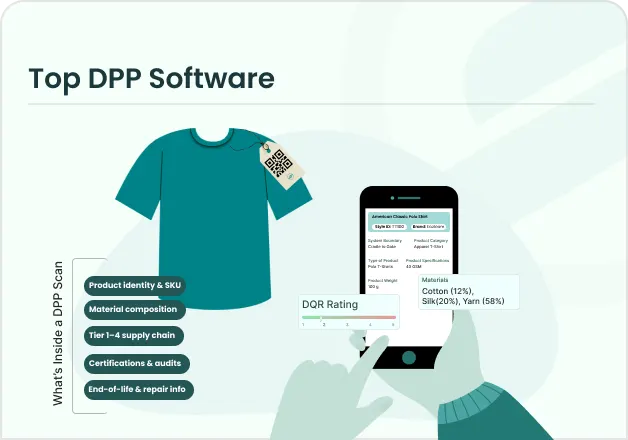

Not all Digital Product Passport platforms are built for fashion. We graded six of them across seven criteria. Here’s the full breakdown.
The Digital Product Passport is already part of EU law, with textile-specific delegated acts expected in 2027, followed by a minimum 18-month transition period.That sounds far away but it isn’t. This preparation window is needed for brands to build a real data foundation and not scramble for a compliance shortcut twelve months before the deadline.
The trouble is that the market is noisy. The DPP landscape spans physical tag providers, luxury digital identity platforms, ERP integrators, SaaS compliance platforms, and dozens of emerging specialists, and every single one of them has a landing page that says “ready for ESPR.” So how do you actually choose?
We evaluated six DPP platforms against seven criteria that matter specifically to fashion, textile, and lifestyle brands and are presenting our findings to you in this blog.
What Actually Matters for a Fashion DPP
These are the seven dimensions that separate a tool that works from a tool that looks good in a demo.
1. Textile Specificity
Does the platform understand the difference between a spun yarn and a woven fabric? Does it have field logic for fibre composition, dyeing processes, and material blends? Or does it call everything a “product” and make you figure out the rest?
2. ESPR / Regulatory Alignment
Is it built around the actual data requirements of ESPR Annex I and AGEC Article 13 or does it support compliance in the loosest possible sense? EU studies indicate early DPPs will focus on material composition, manufacturing processes, core environmental indicators, chemical compliance, traceability, and durability, repairability, and recyclability attributes. A platform needs to handle all of those natively.
3. LCA Integration
A DPP without verified environmental impact data is just a fancy product label. The best platforms generate DPPs from LCA data, so the environmental metrics in your passport are the same ones feeding your CSRD report without any duplication or inconsistency.
4. Supply Chain Depth
Can it map and verify data beyond your Tier 1 garment factory? A textile supply chain runs from Tier 4 (the cotton farm or polymer plant) through Tier 3 (spinning), Tier 2 (weaving and dyeing), and Tier 1 (cut-and-sew) before you even reach your warehouse. A shallow DPP that only sees one tier is a liability when regulators ask for provenance.
5. Consumer Experience
The consumer-facing QR scan is the moment the DPP comes alive. Is the resulting page beautiful, mobile-optimised, and genuinely informative?
6. ERP / PLM Integration
Fashion brands already live in their ERP and PLM systems. A DPP platform that requires manual data entry across thousands of SKUs will collapse under the weight of a real product catalogue. Native integrations with systems like Dynamics 365, NetSuite, Centric PLM, and WFX are the bare minimum you should look for.
7. Ease of Implementation
The best tool in the world is useless if it takes 18 months to go live. Time-to-value matters, especially with compliance windows tightening.
Implementation, supplier onboarding and data collection usually cost more than the software licence. For planning ranges, see how much a Digital Product Passport costs.
Scorecard
| Platform | Textile Specificity |
ESPR Align | LCA Integration |
Supply Chain Depth |
Consumer UX |
ERP/PLM Fit |
Ease of Implementation |
|---|---|---|---|---|---|---|---|
| GreenStitch.io | |||||||
| Avery Dennison / atma.io | |||||||
| Arianee | |||||||
| Kezzler | |||||||
| Renoon | |||||||
| Spherity |
Here are the Top Digital Product Passport (DPP) for Fashion, Textiles & Lifestyle 2026
1. GreenStitch.io
Best overall for fashion, textiles & lifestyle | The only purpose-built platform
GreenStitch is one of the only DPP platforms where every feature was designed by people who understand why the same fabric sourced from different countries have meaningfully different environmental footprints.
GreenStitch generates SKU-specific Digital Product Passports by pulling verified data from LCA, BOMs, and supplier declarations. Each passport is structured for ESPR Annex I, AGEC Article 13, and upcoming EU DPP technical formats. They will also continue to evolve as the format evolves.
Rather than a claim, this is an architecture decision because the DPP is the natural output of a system that has already verified the data upstream. You don’t have to manually format the data or duplicate efforts.
The supply chain depth is where GreenStitch genuinely separates from every platform on this list. The platform captures detailed product attributes including GTIN/style, weight, material composition, recycled content, production methods, packaging, and functional category, all aligned with EU interoperability standards.
It also embeds science-based impact metrics across the full lifecycle:
- Raw material extraction to manufacturing to use to end-of-life (Cradle to grave)
- Scope 1, 2, and 3.1 emissions
- Water use, energy intensity, and recyclability
On the integration front, GreenStitch integrates seamlessly with Dynamics 365, NetSuite, WFX PLM, Infor CloudSuite, Dynamics 365 Supply Chain Management, Centric PLM, and WFX Cloud ERP. So, it connects to the actual systems that fashion brands use to run their operations. Verified users on both G2 and Capterra specifically call out ease of implementation, better customer support, ease of integration, and the quality of the user interface and data processing.
The most important differentiator for 2026 and beyond is that GreenStitch does not silo the DPP. Its DPP offering sits within a unified platform that also handles:
- Carbon accounting
- Product LCA
- ESG reporting
- Supply chain decarbonisation
- CSRD compliance
When regulators start requiring DPP data to align with CSRD disclosures, brands that built their DPP on a separate tool will have to go through a painful reconciliation exercise. GreenStitch users will update one record and every output stays consistent.
Who it’s for: Any fashion or textile brand that wants to be genuinely ESPR-compliant. Small and mid-market to enterprise. Particularly strong for brands with complex, multi-tier supply chains across multiple geographies and regulatory environments.
The one thing to know: This is a complete sustainability platform. If you want something you can deploy in a week without touching your supply chain data, this is not it. But if you want something that will still be working correctly in 2030, this is the best choice.
2. Avery Dennison / atma.io
Best for physical tag infrastructure at enterprise scale
Avery Dennison did not start as a software company. It started as a label company and that history is both its greatest strength and its most revealing limitation.
Through atma.io, a connected product cloud platform, Avery Dennison tracks 30 billion items across the supply chain for global brands, capturing information vital for DPP including carbon footprint data, origins of materials, and reuse instructions. It ranks high on scalability, ecosystem partnerships, and deployment track record.
The DPP Portal within atma.io is capable and self-service for brands that need to upload product master data, bills of materials, and certificates and generate QR codes at scale. For the largest apparel companies in the world, this is a meaningful offering. The platform also has good regulatory credibility. Avery Dennison is an Associate Partner of the CIRPASS consortium, working directly with 30 other partners actively contributing to the development of policy and common principles for DPP deployment across value chains including apparel.
Its shallow LCA data is where it falls short for most fashion brands. Environmental impact reporting requires significant custom configuration. A platform this large and this generalist is not going to have native logic for material-level Scope 3 emissions or the nuanced environmental indicators that ESPR’s textile delegated acts will require. You’re getting excellent hardware and serialisation (the process of converting data or an object into a structured format that can be stored, transmitted, or reconstructed later) infrastructure with a DPP layer on top but not a textile sustainability platform.
Who it’s for: Large, global apparel groups that have already invested in Avery Dennison’s physical label and RFID infrastructure and need a software layer to extend it toward DPP compliance. Or brands prioritising item-level traceability and anti-counterfeiting above environmental data depth.
The one thing to know: atma.io will almost certainly need to be paired with a separate LCA and impact data system to meet ESPR’s environmental data requirements. Budget for that integration.
3. Arianee
Best for luxury fashion DPP and digital ownership
If your products have a waiting list and your customers wear them on Instagram, Arianee is probably the most impressive DPP experience you can deliver. If your products are sold in volume and subject to mandatory EU compliance, the picture becomes more complicated.
Arianee’s DPP solution leverages blockchain to track product lifecycle and ownership securely. Its platform helps businesses in the fashion and luxury sectors meet EU standards by providing a secure, dynamic record of each product’s journey, from production to post-purchase services.
Brands like Moncler, Prada, and Louis Vuitton have used blockchain-based DPPs partly pioneered through Arianee’s architecture to great effect and the consumer-facing experience it creates is premium.
Having said all that, LCA integration is the weakest part of Arianee. Blockchain provides excellent immutability for ownership records but has no native mechanism for calculating or validating environmental impact data. Supply chain depth beyond the brand-to-consumer relationship is limited. And for mid-market or manufacturing-heavy brands whose teams are not fluent in Web3, the implementation complexity is a huge barrier.
Who it’s for: Luxury and premium fashion houses where the DPP is primarily a brand experience and authentication tool, and where the buyer experience is as important as the regulatory data underneath it.
The one thing to know: Luxury ID providers like Arianee that focus on branded resale are surpassed by broader SaaS compliance platforms in terms of cross-industry compliance scope. For mandatory ESPR compliance with robust environmental data, you’ll need supplementary systems.
4. Kezzler
Best for high-volume serialisation across industries
Think of Kezzler as an extremely good engine without a car built around it, at least for fashion.
Kezzler’s Connected Products Platform offers DPP solutions for various industries including food, consumer goods, apparel, and pharmaceuticals. The platform provides traceability across a product’s lifecycle using a digital ID system that complies with EU data transparency standards. Its tools allow supply chain operators to track each product while supporting regulatory demands for transparency.
Kezzler has a proven track record at the kind of serialisation scale that global FMCG and pharma operations demand, and the same core capability does transfer to apparel. Kezzler is known for dynamic QR codes and its item-level tracking is technically reliable.
But, Kezzler was not designed around sustainability data particularly for fashion. LCA integration effectively does not exist in any native sense. The environmental impact fields that ESPR will require, like carbon footprint, water usage, recyclability, chemical compliance, all have to be built on top of Kezzler’s backbone by the brand’s own technical team. That is a significant undertaking, and the output is still more of a bespoke technical project rather than a compliant product.
Who it’s for: Brands that already use Kezzler for item-level traceability or anti-counterfeiting and want to extend toward DPP without switching their serialisation infrastructure. Works best as a tracking layer, paired with a platform that handles the environmental data side.
The one thing to know: Fashion-specific logic and sustainability data fields all have to be custom-built. For most brands, it is more practical to start with a platform that has them already.
5. Renoon
Best for consumer-facing transparency storytelling
Renoon has built a platform that makes it easy for fashion brands to tell their sustainability story to consumers in a clear, structured, credible way. The problem is that “telling the story” and “holding up to regulatory audit” are different standards and the gap between them is growing.
DPP standardisation work progressed significantly in 2025, with the CEN-CENELEC Workshop Agreement CWA providing guidance for setting up Digital Product Passports and related system design options, and CIRPASS-2 running DPP pilots in real settings including textiles. As this standardisation hardens, the requirements for what constitutes a genuine ESPR-compliant passport become more precise and platforms that were built around storytelling rather than structured data compliance face an architecture challenge.
Renoon’s consumer UX scores well as it is well-designed and onboarding is accessible. But the environmental data architecture beneath it is not audit-grade, the ESPR field coverage is incomplete, and supply chain depth at the Tier 2-4 level is limited. Renoon is a communications layer, not a compliance foundation.
Who it’s for: Independent and emerging brands that want a consumer-facing transparency tool now and are not yet under mandatory reporting obligations. Good as a first step into DPP thinking.
The one thing to know: If you deploy Renoon as your DPP system today, you will likely need to replace or substantially extend it when ESPR’s textile delegated acts lock in the required data fields.
6. Spherity
Best for DPP data infrastructure in regulated industries
Spherity is building the pipes. Fashion needs the whole plumbing system, including the taps, the boiler, and someone who knows what a wastewater treatment facility looks like.
Spherity’s decentralised identity and verifiable credentials platform is technically sophisticated and has relevance in the battery passport world, where supply chain provenance and immutable identity records are the core use case. S
For fashion brands, Spherity offers essentially nothing out of the box. No textile-specific data models, no environmental impact calculations, no consumer-facing interface, no PLM integrations. It is a developer toolkit for companies building their own DPP systems which is a legitimate market, just not the market most fashion brands are operating in.
Who it’s for: Technology companies and large enterprises building proprietary DPP infrastructure on top of open standards. Not relevant as a direct DPP solution for fashion brands without a significant custom development investment.
The one thing to know: Spherity’s architecture will likely become more relevant as EU-wide DPP data exchange infrastructure matures. Watch this space for 2028+. For 2026 compliance needs, it does not deliver.
Conclusion
The DPP software market is splitting into platforms that were designed to track objects (serial numbers, ownership records, item locations) and platforms that were designed to track impact (material origins, emissions, water usage, recyclability). Fashion brands need the second type. Most of the market is selling them the first type with a green label added.
A lot of DPP platforms rely on generic spend-based estimates. GreenStitch delivers audit-grade, activity-based emissions linked to actual material, process, and supplier data. Its platform integrates with ERP and PLM systems and enables SKU-level hotspot detection, scenario modelling, and science-based target tracking, built specifically for fashion and textiles.
Activity-based data tied to actual materials and processes, not proxies is what will separate a DPP that passes regulatory audit from one that doesn’t. For apparel and footwear brands operating in the EU market, the Digital Product Passport will be one of the most visible indicators of a company’s environmental performance.
Avery Dennison brings unmatched scale for physical-to-digital infrastructure. Arianee brings genuinely stunning consumer experiences for luxury. Kezzler brings serialisation depth. Renoon brings accessibility. Spherity brings technical rigour for infrastructure builders.
But if you are a fashion or lifestyle brand looking for one platform that can take verified supply chain data, calculate real environmental impact, generate audit-ready passports per SKU, align with every relevant regulation from ESPR to AGEC to CSRD, and do all of it in a system designed by people who actually understand the difference between a conventional cotton and an organically certified one, the answer is GreenStitch.
Frequently Asked Questions
When are DPPs mandatory for fashion brands? The Digital Product Passport is already part of EU law, with textile-specific delegated acts expected to be adopted in 2027, followed by a minimum 18-month transition period, meaning implementation is expected to start from 2028 onward. Brands should be building their data foundation now.
What data must a textile DPP contain? Early DPPs will focus on material composition and weights, key manufacturing processes, core environmental indicators including climate, energy, and water, chemical compliance references, basic traceability information, and durability, repairability, and recyclability attributes.
What makes DPP software “fashion-specific”? Fashion-specific DPP software has native field logic for fibre blends, processing steps like dyeing and finishing, and multi-tier supply chain traceability. It integrates directly with PLM systems, generates LCA-backed environmental data per SKU, and aligns with fashion-relevant regulations. Generic platforms require brands to build all of this from scratch.
How much does DPP software cost? Published prices range from about €29 a month for self-service tools to several thousand euros a month for enterprise platforms, but the full programme is usually higher once data collection and implementation are included. Our Digital Product Passport cost guide breaks this down by brand size.
Do I need separate DPP and carbon accounting software? The most operationally efficient approach, and the one that produces the most consistent, audit-ready data, is a unified platform that generates DPPs as one output of the same underlying dataset that feeds your carbon accounting, LCA, and ESG reporting.
Ready to see what a fashion-native DPP actually looks like in practice? Book a demo with GreenStitch and get your first SKU-level passport live in weeks.