
Lyocell is a regenerated cellulosic fibre made from wood pulp in a closed-loop solvent process, where most of the solvent is recovered and reused. TENCEL is Lenzing’s brand name for it. The fibre drapes well and takes colour cleanly, and it appears in dresses, shirting, bedding and denim blends. The carbon footprint of lyocell averages 2.19 kg CO₂e per kg of fibre, with branded TENCEL Lyocell at 1.09. As finished knit fabric those become around 14.36 and 13.26 kg CO₂e per kg, which is a much smaller gap than the fibre figures suggest.
What are the CO₂e emissions of lyocell?
2.19 kg CO₂e per kg of generic lyocell fibre
1.09 kg CO₂e per kg for TENCEL Lyocell
The figure covers cradle-to-gate production, i.e. forestry and pulp supply, the solvent process that dissolves and regenerates the cellulose, and spinning into filament. It stops at fibre ready to process.
The closed-loop solvent recovery that defines lyocell is what separates it from viscose in process terms. In carbon terms, on generic figures, that separation is smaller than most people expect.
Lyocell and viscose are effectively the same on generic figures
| Fibre | kg CO₂e per kg |
|---|---|
| TENCEL Lyocell | 1.09 |
| Cotton, global average | 2.13 |
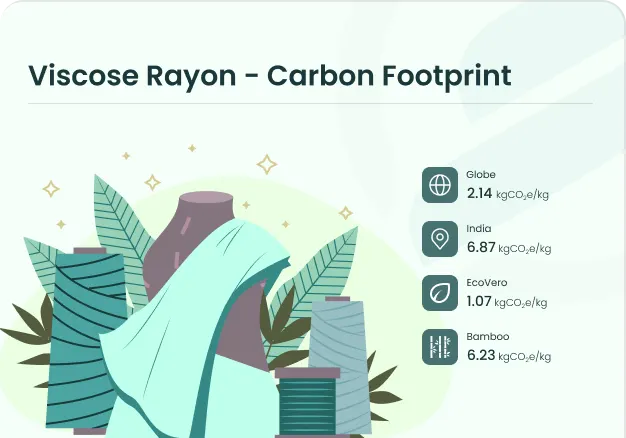
| Viscose, generic | 2.14 |
| Lyocell, generic | 2.19 |
Generic lyocell sits within 2% of generic viscose. Switching a fabric from viscose to lyocell, without specifying a brand, buys almost nothing in carbon terms.
The reduction people associate with lyocell comes from the branded fibre rather than from the lyocell process itself. That is a distinction worth holding onto, because a materials brief that says “move to lyocell” and a brief that says “move to TENCEL Lyocell” produce very different footprints.
Branded and generic figures are exactly double
TENCEL Lyocell is 1.09 and generic lyocell is 2.19. Carbon and water are both exactly double between the two.
A ratio that clean across two independent measures points to one figure having been derived from the other rather than the two being measured separately. The gap is therefore best read as a modelling assumption, and presenting it as a measured 50% reduction would overstate what is actually known.
Both numbers remain usable. The caution applies to the comparison between them, not to either on its own.
SeaCell
SeaCell, the seaweed-blended cellulosic, carries the same 1.09 kg CO₂e per kg as TENCEL Lyocell.
We arrive at this number by using TENCEL Lyocell as the proxy, on the reasoning that SeaCell is a regenerated cellulose fibre made by the same lyocell process, with roughly 1% seaweed content and the balance wood pulp. The reasoning holds, and it is a substitution rather than a measurement, so it should be disclosed if SeaCell appears in a published product footprint.
Lyocell fabric carbon footprint
Fibre is where the count starts, not where it ends. Spinning, knitting or weaving, preparation, dyeing and finishing all add before there is fabric a garment can be cut from.
Knit fabric: 14.36 kg CO₂e per kg Woven fabric: 18.01 kg CO₂e per kg
| Stage | kg CO₂e per kg |
|---|---|
| Lyocell fibre | 2.19 |
| Ring-spun yarn | 2.41 |
| Circular knitting | 6.97 |
| Scouring and bleaching | 0.30 |
| Vat dyeing | 2.36 |
| Finishing | 0.13 |
| Knit fabric | 14.36 |
Fibre is 15% of the finished knit fabric total. Built on TENCEL Lyocell instead, the knit total is 13.26 against 14.36, so the branded fibre’s advantage narrows from a halving at fibre stage to about 8% once the fabric is finished.
Woven fabric comes to 18.01, because weaving costs 10.18 kg CO₂e per kg against 6.97 for circular knitting. Where a fibre can go either way, construction is worth settling early.
We calculate these totals on one construction: ring-spun yarn, batch dyeing and a light finish. A different spinning system, dye class or finishing route moves the number. Heavier finishing adds more than the figure above allows for, and the loss between fibre bought and fabric delivered is not counted, so treat these as a floor rather than a ceiling.
Lyocell water use
Lyocell uses 0.53 m³ of water per kg of fibre, and TENCEL Lyocell 0.26, against 0.75 for global-average cotton.
Both sit below cotton. Neither is as low as viscose at 0.05, which is a reminder that the closed-loop process is about solvent recovery rather than water reduction.
What lyocell means for a product footprint
A lyocell blouse using 180 grams of fibre:
| Fibre choice | Fibre-stage emissions |
|---|---|
| TENCEL Lyocell | 0.20 kg CO₂e |
| Viscose, generic | 0.39 kg CO₂e |
| Lyocell, generic | 0.39 kg CO₂e |
Specifying TENCEL rather than generic lyocell halves the fibre-stage figure. Specifying generic lyocell rather than generic viscose changes it by less than 0.01 kg CO₂e, which is not a difference worth putting in a brief.
Those are fibre-stage figures. A blouse is woven, so at fabric level the same garment carries around 3.24 kg CO₂e in generic lyocell and 3.04 in TENCEL. Lyocell fabrics are often enzyme-washed or peach-finished, which is a heavier finishing route than the one in the build above and adds further.
What these figures cover
Two boundaries on this page. The fibre figures cover forestry through to spun filament. The fabric figures add spinning, knitting or weaving, preparation, dyeing and finishing on one stated construction. Garment making, transport, use and end of life sit outside both.
These are sector averages, or figures the producer publishes. Neither describes your own supply chain.
These are older figures. Lyocell capacity has expanded and the process has been optimised since they were put together, so they are more likely to overstate current production than understate it. If lyocell is material to your footprint, ask your supplier for current published data.
No regional split. Production is concentrated in Austria, China and Thailand, with different grid intensities. None of that is captured.
No recycled lyocell figure. None is available.