
The fashion industry is one of the largest contributors to environmental degradation, accounting for 10%–15% of total EU emissions and nearly 20% of global freshwater pollution. From excessive water use in cotton farming to the energy-intensive production of synthetic fibres, the environmental impact of textiles is undeniable.
Consumers are paying attention. A Eurobarometer poll found that 73% of European consumers consider a product’s environmental impact when making a purchase. But with so many sustainability claims in the market, how can brands prove their commitment to the environment, and how can consumers trust these claims?
That’s where the EU’s Ecolabel comes in.
What is the EU Ecolabel?
The EU Ecolabel is a voluntary certification awarded to textile products that meet the highest environmental standards across their entire lifecycle. Established by the European Union, it ensures that certified products are produced with fewer emissions, consume less water and energy, and contain minimal hazardous substances—all while maintaining durability and high quality.
Unlike generic sustainability claims, the EU Ecolabel is a trusted, third-party certification backed by strict scientific criteria and regulatory compliance.
To develop these standards, the EU conducted extensive Life Cycle Assessments (LCAs) to identify the biggest environmental “hotspots” across different textile materials, such as:
- Cotton production – Major contributors to ecotoxicity include fertilisers, pesticides, and excessive water usage in irrigation.
- Synthetic fibres (nylon, acrylic, polyester) – Require high energy inputs, are difficult to recycle, and contribute to microplastic pollution.
- Viscose & cellulose fibres – Have specific processing challenges impacting emissions and water pollution.
Using insights from these studies, the EU Ecolabel was designed to recognise only the top 10–20% of textile products with the lowest environmental impact. Rather than applying broad sustainability standards, it sets strict benchmarks for certification, ensuring only the most responsible products receive the label.
This cradle-to-cradle approach evaluates a product’s entire lifecycle—from raw material sourcing and energy consumption to recyclability and hazardous substance restrictions. It guarantees compliance with EU sustainability laws while helping brands prove their environmental responsibility and giving consumers confidence in their purchases.
The EU Ecolabel applies to a wide range of textile products, including clothing, accessories, interior textiles, fibres, yarns, fabrics, and knitted panels.
The label guarantees:
- More sustainable fibre production.
- A less polluting production process.
- Strict restrictions on hazardous substances.
- Longer-lasting, higher-quality final product.
By certifying only the most responsible textile products, the EU Ecolabel helps brands prove their sustainability claims—and gives consumers a trusted way to shop greener.
Why It Matters for Fashion & Textile Brands
- Building Consumer Confidence in Sustainability: With sustainability claims flooding the market, trust is everything. The EU Ecolabel serves as a gold standard, giving consumers confidence that certified products meet strict environmental and social criteria.It ensures that textiles are made from responsibly sourced raw materials, manufactured using resource-efficient processes, and free from hazardous substances—all while maintaining high durability and quality.Four out of five European consumers prioritise sustainability when making a purchase, yet many struggle to verify a brand’s claims.The EU Ecolabel bridges this gap by providing third-party certification aligned with key regulations like the Green Claims Directive and the Ecodesign for Sustainable Products Regulation, and by extension Digital Product Passport. In an industry filled with vague claims, this label stands out as a mark of genuine commitment to sustainability.
- Eliminating Hazardous Substances from Textiles: Toxic chemicals have long been a hidden cost of textile production, but not anymore. The EU Ecolabel sets strict limits on hazardous substances, requiring brands to replace harmful chemicals with safer alternatives.This includes banning or restricting azo dyes, formaldehyde, heavy metals like lead and chromium, phthalates, certain flame retardants, perfluorinated chemicals (PFCs), and other pollutants commonly found in textiles.To earn certification, companies must not only meet these strict thresholds but also provide documented proof through verification and testing, ensuring that sustainability claims are backed by real action.
- Driving Innovation for a Sustainable Future: By imposing strict environmental standards, the EU Ecolabel is challenging businesses to innovate and develop durable, repairable, and easily recyclable textiles.To meet certification requirements, companies must rethink materials, adopt cleaner production methods, and invest in sustainable design.For example, Denmark-based brand Neutral has embraced low-impact dyes certified by Oeko-Tex Standard 100, eliminating carcinogenic, mutagenic, and metal-based chemicals from its manufacturing process. By rewarding forward-thinking solutions, the EU Ecolabel fosters industry-wide innovation, ensuring that sustainability and product performance go hand in hand.
- Reducing Water and Air Pollution: The EU Ecolabel enforces strict limits on water and air pollution in textile manufacturing. Facilities using water retting must treat wastewater to reduce Chemical Oxygen Demand (COD) and Total Organic Carbon (TOC), with discharge limits set at 20 g COD/kg textiles processed.Similarly, air emissions from printing and finishing cannot exceed 100 mg C/Nm³. Companies must verify compliance through ISO 6060 test reports.Beyond reducing pollution, these standards help brands attract sustainability-conscious consumers. Companies like Lenzing AG, the first fibre manufacturer to receive the EU Ecolabel in 2002, have used certification to set industry benchmarks and strengthen market leadership.
What Does It Take to Earn the EU Ecolabel?
The EU Ecolabel criteria are designed to recognise only the top 10–20% of textile products with the best environmental performance in the European Economic Area (EEA). Developed using scientific data and Life Cycle Assessments (LCAs), these criteria assess a product’s entire lifecycle—from raw material sourcing to end-of-life disposal.
Beyond reducing environmental impact, the standards also account for health, safety, social, and ethical considerations. They promote the replacement of hazardous substances with safer alternatives, encourage the use of durable and recyclable materials, and support higher recycled content in textiles.
The table below provides a breakdown of the EU Ecolabel’s key criteria, including examples and verification methods used by regulatory authorities.
| Criteria | Description | Requirements | Assessment & Verification |
|---|---|---|---|
| Textile Fibres | The EU Ecolabel criteria apply to a wide range of textile materials, including both natural and synthetic fibres. These include cotton and other cellulosic seed fibres, flax and bast fibres, wool and keratin-based fibres, as well as synthetic options like acrylic, elastane, polyamide, polyester, and polypropylene. Additionally, the criteria cover man-made cellulose fibres such as lyocell, modal, and viscose, along with textile fillings, coatings, laminates, membranes, and accessories. |
Specify the complete composition of the product, identify the textile fibre, components & accessories and show compliance towards their permissible limit in the product content.
Example: Conventional cotton should be made without the use of pesticides Aldicarb, aldrin, campheclor (toxaphene), captafol, chlordane, etc. |
Fibre and component manufacturers, their raw material and chemical suppliers and testing laboratories working in accordance with the specified test methods.
Example: Cotton to be tested using US EPA 8081 B, 8151 A, 8141 B, 8270 D. |
| Chemicals & Processes | The criteria apply to spinning, fabric formation, pre-treatment, dyeing, printing, finishing and cut/make/trim. |
Specify the substances, production recipes and technologies used to manufacture and impart specific qualities and functions to the product.
Example: Wastewater discharges must not exceed 20 g COD/kg textiles processed. |
Ensure production sites and suppliers follow specified test methods. Annual testing required.
Example: Submit documentation based on ISO 6060 and ISO 7887 covering the last 6 months. |
| Fitness for Use | Criteria include dimensional changes, colour fastness, resistance to rubbing, light, pilling, abrasion, and durability of functions like flame retardancy. |
Meet defined thresholds.
Example: Shrinkage for knitted fabric ≤ ±4%, chunky knit ≤ ±6%, interlock ≤ ±5%. |
Testing via certified methods.
Example: Use EN ISO 6330 + EN ISO 5077. Test over 3 wash/dry cycles. Submit report. |
| Corporate Social Responsibility | Covers ILO standards, ban on denim sandblasting. |
CMT suppliers must comply with ILO principles.
Example: Same shrinkage limits as above apply. |
Verified via third-party audits and documentation.
Example: Audits required at application and for new sites during license period. |
How to Apply for the EU Ecolabel
Any producer, manufacturer, importer, service provider, or wholesaler selling products in the European Economic Area (EEA)—which includes the EU, Liechtenstein, Norway, and Iceland—can apply for the EU Ecolabel.
The application process is conducted online and must be approved by a designated competent body before certification is granted. This involves a structured seven-step evaluation, ensuring that every product meets the Ecolabel’s strict environmental and performance criteria before it receives official recognition.
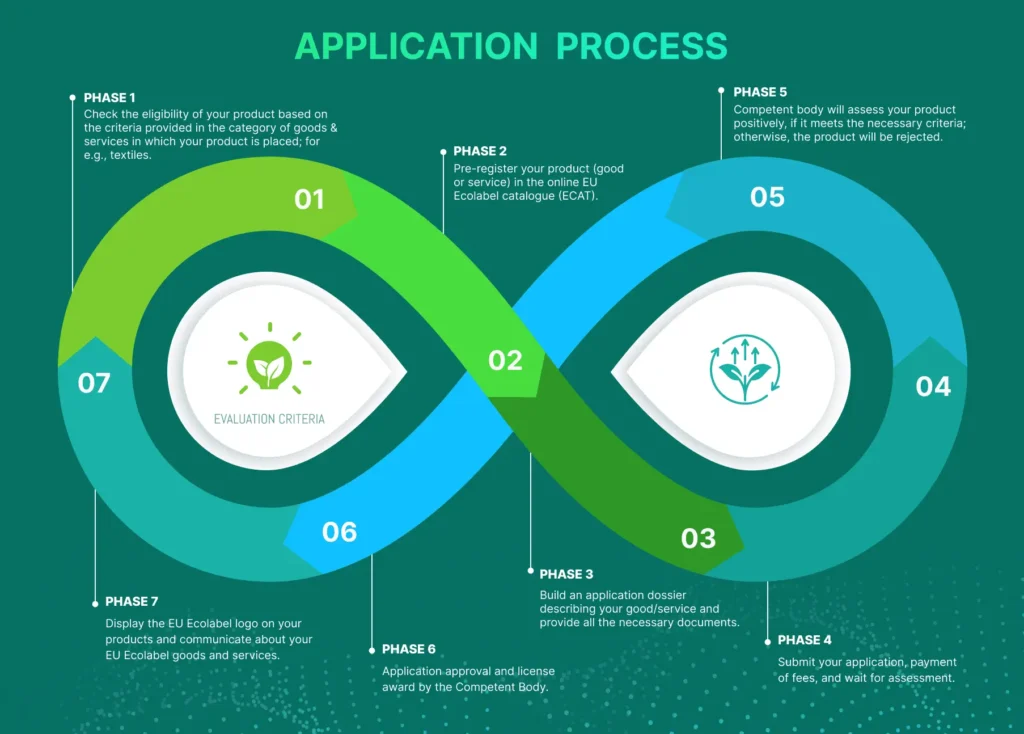
The application process is rigorous, and companies must carefully consider several factors before submission:
- Selecting the Right Competent BodyA Competent Body is the designated authority responsible for assessing applications, verifying compliance, and granting the EU Ecolabel. Choosing the correct authority depends on where the product originates:
- Within the EEA: Companies must apply to the Competent Body of the country where the product is produced.
- Multiple EEA Countries: If the product is manufactured in more than one EEA state in the same form, the application can be submitted to a Competent Body in any of those countries.
- Outside the EEA: Companies must apply to the Competent Body of an EEA country where they intend to sell their product.
- Identifying the Correct Product CategoryEach product group under the EU Ecolabel has specific criteria outlined in Article 1 of the Ecological Textile Criteria. Companies must ensure that their product meets the defined requirements for material composition, production processes, and environmental impact before applying.
- Ensuring License TraceabilityOnce approved, an EU Ecolabel license is granted through a contract between the competent authority and the license holder. To enhance transparency, companies must pre-register their certified products on the EU Ecolabel Catalogue (ECAT), ensuring consumers can verify their sustainability credentials. Proper registration helps maintain traceability and reinforces trust in the ecolabel.
- Verification and AssessmentTo qualify for the EU Ecolabel, companies must meet strict verification requirements. This includes submitting declarations, supporting documentation, test reports, and third-party certifications that confirm compliance with ecolabel criteria across the entire supply chain.For example, textile products containing recycled content must adhere to specific guidelines:j
- Definition: Recycled fibres must originate from pre-consumer waste (e.g., polymer and fibre production waste, textile cuttings) or post-consumer waste (e.g., discarded textiles, PET bottles, fishing nets).
- Composition Requirement: At least 70% of the fibre content must be recycled material.
- Assessment Criteria: Recycled content must be fully traceable to the original waste material and reprocessing stage.
- Verification: Companies must provide third-party certification for the chain of custody or supporting documentation from feedstock suppliers and reprocessors.
- Integrating Life Cycle Assessment (LCA)To qualify for the EU Ecolabel, companies must conduct a Life Cycle Assessment (LCA) for their textile products. This process requires collecting and analysing detailed environmental data across every stage of production—from fibre manufacturing and spinning to ginning, weaving, dyeing, and final fabric production.By evaluating resource consumption and environmental impact throughout the product’s lifecycle, the EU ensures that only textiles with a reduced footprint receive certification.
- Ensuring Compliance with EU RegulationsThe EU Ecolabel is not just a standalone certification—it aligns with broader sustainability regulations. License holders must comply with existing directives such as the Green Claims Directive, Ecodesign for Sustainable Products Regulation, and the Directive on Empowering Consumers for the Green Transition.By integrating these frameworks, the ecolabel serves as a trusted marker of regulatory adherence and environmental responsibility.
- Supply Chain Declarations & DocumentationCompanies must also ensure full supply chain transparency. The EU Ecolabel requires detailed declarations on permissible components and environmental limits from every key supply chain stakeholder, including:
- Fibre suppliers
- Spinners
- Fabric manufacturers
- Dyeing, printing, and finishing units
- Component and accessory suppliers
- Retailers
- Chemical suppliers
- The origin of recycled fibres (pre-consumer vs. post-consumer waste).
- Compliance with the 70% minimum recycled content requirement.
- Full traceability through third-party certification or supplier documentation.
Conclusion
Achieving the EU Ecolabel requires more than just meeting sustainability benchmarks—it demands robust data collection, verification, and supply chain coordination.With dozens of suppliers involved and hundreds of declarations to submit, managing compliance manually can be overwhelming.
For many companies, the biggest challenge is data fragmentation, with critical ESG data scattered across different suppliers, systems, and formats. Without a centralised data strategy, tracking environmental performance and ensuring compliance becomes a tedious and resource-intensive process.
This is where AI-powered sustainability platforms like GreenStitch make a difference. By integrating carbon accounting, life cycle analysis (LCA), and ESG reporting into a single, streamlined system, GreenStitch helps businesses:
- Automate data collection from supply chain partners.
- Ensure real-time compliance with evolving EU regulations.
- Generate verified reports for ecolabel applications and sustainability disclosures.
As regulatory requirements tighten, brands that digitise and centralise sustainability data will gain a competitive edge, making compliance faster, easier, and more transparent.
References
- Consolidated text: Commission Decision of 5 June 2014 establishing the ecological criteria for the award of the EU Ecolabel for textile products (notified under document C(2014) 3677) (Text with EEA relevance) (2014/350/EU)Text with EEA relevance
- EU Ecolabel Factsheet, European Union
- EU Ecolabel facts and figures, European Union
- EU Ecolabel, 7- step application process, European Union
- EU Ecolabel Product Catalogue, European Union
- EU Ecolabel Textiles Technical Report, European Union
- New legislation gives EU Ecolabel big thumbs up - good news for businesses and consumers, European Union