
The fashion industry has no shortage of sustainability claims. From “eco-conscious capsules” to “climate-neutral collections”, green marketing has become a badge of honour and a strategic differentiator. But behind the glossy packaging and bold statements lies a growing credibility problem. Consumers are demanding proof. And the EU responded with one of its most ambitious policies yet: the Green Claims Directive.
Proposed as part of the European Green Deal, the Green Claims Directive sets out to eliminate greenwashing by establishing strict rules on how brands substantiate and communicate environmental claims.
Introduced by the European Commission in March 2023, and now under final negotiation, which is expected to end by 2025. The Member States will enforce the Green Claims Directive by 2027
The originally proposed EU Green Claims Directive has been withdrawn by the European Commission in 2025. This article reflects the directive as it was proposed. Businesses should instead refer to the Empowering Consumers for the Green Transition Directive (ECGT), which is now the primary EU framework governing environmental claims, with enforcement starting from September 2026.
So what does this mean for your brand? In this article, we break down what the Green Claims Directive means for the industry, how to prepare, and why compliance may be the best branding move you’ll make in 2025.
Fashion’s Greenwashing Problem—and Why the EU Is Cracking Down
Walk into any retail store or scroll through a brand’s landing page, and you’ll find a flood of claims: “environmentally sustainable”, “eco-friendly”, “fair trade”, “carbon neutral”. On paper, it sounds like the fashion industry has gone green. But behind those buzzwords lies a growing crisis of trust.
After years of lawsuits involving Shein, Zara, Boohoo, Nike, and H&M, the public is beginning to associate sustainability labels not with climate action, but with greenwashing. The reason is simple: these claims are often vague, unverifiable, or wildly misleading.
And yet, green sells. According to a McKinsey & NielsenIQ study of over 600,000 SKUs, products making ESG-related claims saw 28% more cumulative growth over five years than those that made none. The financial incentive to appear sustainable, without actually being sustainable, is significant.
That’s where the EU Green Claims Directive comes in.
It draws a clear legal line between actual sustainability and creative storytelling. Aimed to restore credibility to environmental marketing and prevent greenwashing from derailing climate and circularity goals.
The Directive complements the Empowering Consumers for the Green Transition Directive (EmpCo)—a related law adopted earlier that bans vague green claims like “climate neutral” unless backed by hard evidence. While EmpCo focuses on banning deceptive language, the Green Claims Directive sets strict standards for how claims must be proven and communicated.
Together, these directives are part of a wider “green transition” agenda aimed at reshaping the EU economy around sustainable production, transparency, and circularity.
For the fashion and textile sector, where sustainability has often been leveraged more as a branding tool than an operational standard, this regulatory shift is forcing brands to make sustainability part of their business model and not just use it as a marketing strategy.
What Does the Green Claims Directive Cover?
The Directive is laser-focused on one thing: making sure that if a product is marketed as sustainable, it genuinely is—and that the company behind it can prove it.
But what exactly does the Green Claims directive regulate?
At its core, the directive targets any voluntary environmental claims, written or oral, made by a business selling to EU consumers, whether it’s a product label, an Instagram caption, or a bold sustainability statement on a corporate website. This includes:
- Fashion and textile brands operating in the EU
- Non-EU companies marketing products to EU consumers
- Manufacturers, retailers, DTC platforms, and B2C aggregators
Microenterprises—businesses with fewer than 10 employees and under €2 million in turnover—are formally exempt. This means microenterprises are not legally required to substantiate green claims under the Directive, though they may voluntarily obtain a EU-wide Certificate of Conformity if they choose to comply with the standards voluntarily
Types of Green Claims Regulated
The directive draws a clear line between mandatory disclosures (those already required under other EU regulations, for example, the EU Ecolabel) and voluntary environmental claims. It focuses on the latter—claims that brands choose to make as part of their sustainability narrative. These include:
1. Explicit Product-Level Claims
These are the everyday marketing statements that appear on hangtags, packaging, websites, and lookbooks, such as:
“100% recycled polyester”, “Low-carbon denim”, “Biodegradable packaging”
Under the Green Claims Directive, such claims must now be specific, quantifiable, and scientifically substantiated. Vague phrases like eco-conscious, planet-friendly, or green collection will no longer cut it—unless they’re backed by data, verified by independent third-party experts.
2. Corporate-Level Environmental Messaging
The directive also covers broader statements about a brand’s sustainability performance, such as:
“Our operations are carbon neutral”, “We’ve reduced our water footprint by 50%”
These claims must be supported by up-to-date, standardised evidence (e.g., third-party-verified LCAs or PEF calculations), and they must clarify whether they apply to the whole business or just a part of it.
3. Offset-Based and Climate Neutrality Claims
This is where the directive gets stricter. Claims that rely on carbon offsetting, such as “Carbon neutral packaging”, “100% climate compensated shipping”, will be subjected to additional scrutiny. Brands will need to disclose:
- What part of the claim is based on offsets
- The type, quantity, and standard of carbon credits used
- Whether those credits are certified under recognised frameworks (e.g., the EU Carbon Removals Certification Framework)
If companies rely on offsets, you need to be transparent about how and why. Accurate carbon emissions data is critical for verifying impact claims and offset disclosures.
How Environmental Labels and Labelling Schemes Will Be Regulated Under the Green Claims Directive
Environmental labels are everywhere in fashion, a green tag, a recycled icon, a planet symbol—all signal that a product is responsible, ethical, and better.
But not all of these labels are equal. Some are certified by independent experts. Many are invented in-house.
The Green Claims Directive introduces clear rules on how both environmental labels and environmental labelling schemes will be defined, governed, and used within the EU.
- Environmental Labels refer to any trust mark, quality mark, symbol, badge or graphic that implies environmental excellence or performance.
- Environmental Labelling Schemes (ELS) are the certification systems behind those labels that verify environmental claims and labels at the product, process, or company level. They include private and public ecolabel programs, like the EU Ecolabel or ISO 14024 Type I schemes.
If your brand uses an environmental label on your product, hangtag, website, or ad, the Green Claims Directive requires that:
- The claim behind the label must be verified by a 3rd party.
- The label must be linked to a substantiated environmental performance
- Supporting documentation must be made publicly accessible—often via a QR code or web link.
Once verified, a certificate of conformity is issued and recognised EU-wide.
That means labels that are vague (“eco-friendly”), self-created, or based solely on carbon offsets without disclosure will no longer be allowed.
The directive goes even further when it comes to regulating how environmental labelling schemes operate, especially new ones. The requirements include:
- Independent 3rd party verification of scheme criteria and governance
- Transparent ownership and oversight
- Scientific substantiation of the criteria used
- Stakeholder involvement, including complaint mechanisms and dispute resolution
- Regular review and updates to maintain credibility
New public or private ecolabels will be banned unless:
- They’re established by EU legislation, or
- They demonstrate clear added value to the EU market, such as covering an unaddressed impact or setting a higher standard.
Labels already governed under other EU law, like the EU Ecolabel, organic certifications, or EMAS, are exempt from GCD 3rd party verification. However, companies using them must still ensure accurate communication and proper usage. Similarly, if your claims are regulated by other EU Law, then those claims are exempt from the Green Claims Directive.
Want to know if the EU Ecolabel applies to your product? Read our full explainer on the EU Ecolabel for fashion and textiles.
How Can Fashion and Textile Businesses Substantiate Green Claims
Every explicit or implicit environmental claim you make—whether it’s “climate neutral,” “made from organic cotton,” or “low water footprint jeans”—must now be supported by:
- Recognised scientific evidence
- Life Cycle Assessment (LCA) or equivalent methodology
- Clear, specific impact data (e.g. carbon, water, durability)
- Details on the methodology used and any trade-offs involved
In most cases, the EU encourages using the Product Environmental Footprint (PEF) methodology to substantiate claims. It’s a lifecycle-based tool developed by the European Commission to harmonise how environmental claims are assessed across industries.
For the textile sector, this means referencing PEF Category Rules (PEFCRs) guidelines that are developed specifically for garments and footwear— it accounts for fibre type, dyeing methods, chemical inputs, and end-of-life recycling potential.
Making a claim like “50% less carbon impact compared to 2020”? You’ll need to prove it with baseline emissions data, reduction methodology, and third-party verification—before you publish it.
What Counts as Robust Evidence?
To comply with the directive, your claim must demonstrate:
- What environmental aspect is being claimed (e.g., CO₂, water use, durability)
- How the product performs vs. industry benchmarks
- Whether it applies to the whole product, a component, or just the packaging
- Whether it creates unintended trade-offs (e.g., less water use but more chemicals)
- Whether the claim reflects an actual improvement, not just a marketing narrative
Claims that rely only on general terms like “eco-friendly” or “planet-positive” will not be accepted without data.
What About Carbon Offsets?
Carbon offsetting—especially for “climate neutral” claims—faces heightened scrutiny. If you rely on offsets:
- You must separate what’s reduced from what’s offset
- Disclose the type, quantity, methodology, and permanence of credits
- Use only credits that meet EU-recognised standards, such as the Carbon Removals Certification Framework
If you’re using contribution claims (e.g., “we fund forest protection projects”), make sure they’re not framed as direct emission reductions unless verified.
How Much Will Substantiating Your Environmental Claims Cost
Not all claims are created equal, and neither are the costs of verifying them. Based on EU estimates from the Green Claims Directive:
| Type of Claim | Estimated Cost |
| Simple claims (e.g., materials used in production, made with recycled materials) | ~€500 |
| LCA using PEF (with existing PEFCRs) | ~€4,000 |
| LCA without PEFCRs | ~€8,000 |
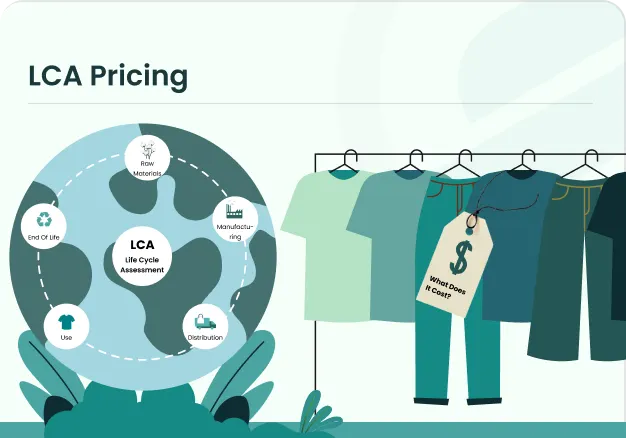
This cost must be borne by the company making the claim. Those EU figures are for a single claim study; catalogue-scale LCA pricing for fashion brands is usually a different budget.
According to the directive, verification costs must be proportionate to the complexity of the claim and the size of the business. But once verified, the Certificate of Conformity is valid EU-wide, removing the need for country-by-country approvals and ensuring legal certainty for cross-border marketing.
What Brands Need to Know about Verification and Certification
Under the Green Claims Directive, independent third-party verification of claims before publication is mandatory
It’s what gives your claim legal standing across the EU, shielding your brand from accusations of greenwashing.
Ex-Ante Verification: The New Sustainability Checkpoint
Before any marketing material, label, hangtag, or digital content goes live, claims must be reviewed and approved by an accredited verifier. This is a qualified, impartial body with no conflict of interest, and with technical expertise in fashion and textile environmental impact.
The verifier will assess:
- Your claim’s alignment with recognised methodologies (like PEF)
- Completeness and accuracy of your evidence
- Whether the environmental performance claimed is significant, specific, and not misleading
Once approved, the verifier issues a Certificate of Conformity, which:
- Confirms compliance with the directive
- Grants the legal right to use the claim across all EU member states
- Simplifies compliance for brands operating in multiple countries
What happens if you don’t comply with the Green Claims Directive
Each member state is required to designate a competent authority to enforce compliance, conduct audits, and investigate suspected violations.
Penalties for non-compliance can include:
- Fines of at least 4% of annual turnover
- Confiscation of products and profits from unverified claims
- Exclusion from public procurement and EU funding for up to 12 months
- Public exposure, including naming and shaming
- In severe cases, advertising licenses may be withdrawn, and companies may be prohibited from promoting sustainability claims
- Consumer groups or other qualified entities can initiate legal proceedings against companies for greenwashing or non-compliance
For fashion brands that trade on their sustainability story, the reputational fallout of non-compliance could be far worse than the financial cost.
How Fashion and Textile Brands Can Prepare for the Green Claims Directive
With the Green Claims Directive set to take effect in the coming years, fashion and textile brands must act now to bring their sustainability claims—and internal processes—up to standard.
- Audit Your Existing Environmental Claims
Begin by reviewing every green claim your brand makes—whether it’s a product tag, a digital ad, or a section in your ESG report. Identify which claims are vague, unverifiable, or lack scientific backing. These are the red flags that will need to be reworded, removed, or rebuilt.
- Set Up Internal Governance
Green claims can no longer sit in marketing alone. Establish cross-functional oversight that brings together sustainability, compliance, legal, and product teams. Define clear roles, responsibilities, and workflows for approving claims before they go public.
- Substantiate Claims with Recognised Scientific Methods
Ensure all claims are supported by robust evidence—ideally through Life Cycle Assessments (LCA) aligned with the EU’s Product Environmental Footprint (PEF) methodology. For textiles, apply the relevant PEF Category Rules (PEFCRs) wherever available.
- Build Verification Into Timelines
Verification is not instant. Working with accredited third-party verifiers will take time, and must now be built into your launch calendars. Without pre-verified claims and a valid Certificate of Conformity, your sustainability messaging risks non-compliance and potential penalties.
- Train Teams on Legal and Marketing Compliance
Equip your teams with the knowledge they need to navigate the directive. Designers, marketers, and product developers must understand not just what they can say, but what they can prove.
- Align Claims with Existing EU Law
Where possible, align your claims with frameworks already recognised under EU law, like the EU Ecolabel or Organic Regulation. These claims are exempt from additional verification under the directive and serve as a fast track to compliance.
Want to know if the EU Ecolabel applies to your product? Read our full guide to the EU Ecolabel for fashion and textiles →
- Strengthen Supply Chain Traceability
To substantiate product-level claims, brands must know exactly what’s happening across their value chain. Invest in tools and processes that allow you to map suppliers, collect environmental data, and verify practices at each tier. This is especially critical for claims tied to fibre content, water use, emissions, and ethical sourcing. The more granular your traceability, the more defensible—and valuable—your sustainability claims become.
Bonus Tip: This also supports compliance with upcoming supply chain due diligence rules such as the Corporate Sustainability Due Diligence Directive (CSDDD).
- Monitor and Track National-Level Implementation
Because this is a directive, not a regulation, each EU Member State will implement it slightly differently. Stay informed about national timelines and enforcement models. Inconsistent rollout could mean a claim allowed in Italy is banned in Germany.
Conclusion
For too long, sustainability claims have lived in the grey area between intention and impact.
Now things are changing, getting compliant means more than tweaking a hangtag or rewording a product description. It requires rethinking how sustainability data is collected, validated, and communicated across your business, from your suppliers to your storefronts.
That’s where Greenstitch comes in.
We help fashion and textile brands turn sustainability ambition into regulatory-ready execution. Our platform automates life cycle assessments, aligns your data with PEFCR standards. From supplier mapping to substantiating product-level claims, Greenstitch gives you the infrastructure to comply with the Green Claims Directive—without slowing down your business.
The rules may be changing. But with the right systems in place, your brand won’t just keep up. It will lead.