
16 December 2025 – The European Parliament has formally approved the Omnibus Agreement, streamlining sustainability reporting requirements. The proposal passed with 428 votes in favour, 218 against, and 17 abstentions on Tuesday, 16 December. The agreement revises compliance obligations under the Corporate Sustainability Reporting Directive (CSRD) and the Corporate Sustainability Due Diligence Directive (CS3D).
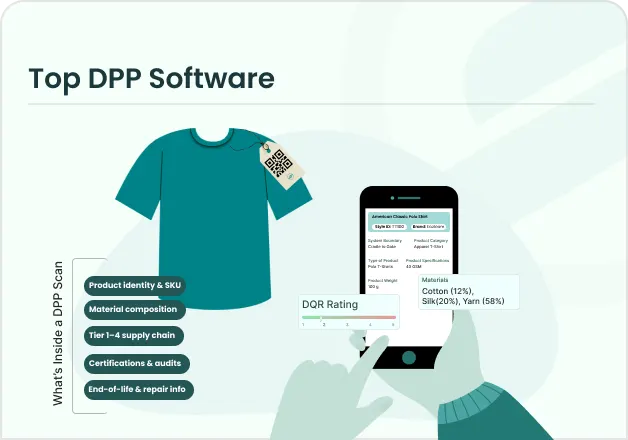
Even with simplified reporting thresholds, product-level rules such as the Ecodesign for Sustainable Products Regulation (ESPR) continue to shape fashion compliance roadmaps.
This update aims to reduce administrative burdens and strengthen competitiveness. The CSRD, which replaced the Non-Financial Reporting Directive (NFRD), is central to standardising sustainability disclosures and supporting the EU’s goal of achieving climate-neutrality by 2050.
Here is a comparison detailing the key changes between the initial structure and the new provisional agreement:
CSRD: Scope and Applicability
The provisional deal raises the compliance thresholds.
| Area of Comparison | Original CSRD Requirement (Pre-Simplification) | Updated CSRD Requirement (Provisional Deal) |
| EU Large Undertakings | Applied to companies meeting two of three criteria: Average of 250+ employees, net turnover over €40M, or total assets over €20M. | Applies only to companies meeting both criteria: Over 1,000 employees AND a net annual turnover over €450 million. |
| Non-EU Undertakings | Required if annual EU revenue was at least €150 million. | Turnover threshold generated within the EU is raised to €450 million (Parent) AND requires a subsidiary or branch in the EU generating >€200 million (Anchor). |
| Listed SMEs | Included in scope (excluding micro-undertakings), with an option to opt-out until 2028. | Removed from the mandatory scope of the Directive. |
| Exemptions | No specific exemptions noted in the original scope. | Financial holding undertakings are exempted from the CSRD’s consolidated reporting scope. |
| Transition Relief | Wave one companies (large public-interest entities already under NFRD) were due to report on 2024 data in 2025. | Companies that now fall out of scope (previously due to start reporting in 2024) are granted an exemption for FY 2025 and 2026. |
CSRD: Reporting and Data Requirements
The CSRD requires reporting based on the principle of double materiality, evaluating both the impact of the company’s operations on ESG issues (Impact Materiality) and how external sustainability matters affect the company’s finances (Financial Materiality).
| Area of Comparison | Original CSRD Requirement (Key Components) | Updated CSRD Requirement (Simplification Measures) |
| Reporting Focus | Mandatory inclusion of prospective information, such as targets, transition plans supporting net-zero by 2050, and documenting the resilience of the business model to sustainability risks. | Reporting requirements will be simplified to prioritize quantitative data over narrative descriptions. |
| Sector Standards | Reporting must align with European Sustainability Reporting Standards (ESRS); topical standards (e.g., ESRS E1 for Climate Change) were mandatory if deemed material. | Sector-specific reporting will become voluntary guidelines rather than mandatory standards. |
| Value Chain | Disclosure required across the entire upstream and downstream value chain. | “Value Chain Cap”: Smaller companies (<1,000 employees) are protected from responsibility shifting; they may legally refuse information requests that exceed voluntary standards. |
| Assurance | All disclosures are subject to mandatory third-party verification, requiring limited assurance initially. | The mandatory roadmap to Reasonable Assurance is scrapped. The legal mandate to adopt stricter audit standards by a specific date was deleted to reduce costs. |
| Format and Support | Reports must be submitted in the European Single Electronic Format (ESEF/XHTML) and digitally tagged using iXBRL. | The Commission is mandated to create a digital portal providing free access to templates and guidelines. |
CS3D: Due Diligence Scope and Practice
The thresholds for the Corporate Sustainability Due Diligence Directive (CS3D) have been increased to focus due diligence obligations solely on very large corporations.
| Area of Comparison | Original CS3D Proposal | Updated CS3D Requirement (Provisional Deal) |
| EU Corporations | Original thresholds were lower | Due diligence applies only to companies with more than 5,000 employees AND a net annual turnover over €1.5 billion. |
| Transition Plans | Obligation for companies to adopt a climate transition plan compatible with the Paris Agreement. | The obligation to adopt a climate transition plan is removed (repealed). |
| Methodology | Implied a potentially comprehensive mapping exercise. | Companies must use a risk-based approach following a general scoping exercise, focusing only on areas where adverse impacts are most likely. |
| Liability and Penalties | Included an EU harmonised liability regime. | Sets a maximum limit of 3% of net worldwide turnover for fines. Member States cannot set fines higher than this ceiling. |
| Deadline | Original deadlines were set earlier. | The transposition deadline is postponed to 26 July 2028, with compliance required by July 2029. |
Jörgen Warborn, the rapporteur, stated that this compromise provides “historic cost reductions for businesses” while confirming that it remains a “win for competitiveness and a win for Europe”. The provisional agreement awaits formal endorsement by both the Council and the European Parliament.
The Legal Affairs Committee will vote on the provisional agreement on 11 December 2025. Then, there will be a plenary vote in Strasbourg during the December parliamentary session. The provisional agreement must be endorsed by both the Council and the European Parliament before formal adoption.