
A Comprehensive Industry Guide for Compliance, Finance, and Operations
With the passage of Senate Bill 707 (Chapter 864, Statutes of 2024), California has enacted the most aggressive Extended Producer Responsibility (EPR) law for textiles in the United States.
Historically, when a consumer discarded a garment, the cost of disposal was borne by municipal taxpayers (landfill management). SB 707 shifts this financial and physical burden to the Producer, much like the EU Waste Frame Directive. If you place apparel or textile articles on the California market, you are now legally responsible for the entire lifecycle of that product, from design to collection, repair, and recycling.
For brands, manufacturers, and retailers selling into California, lifecycle responsibility is becoming a regulated cost center tied directly to product design, sourcing choices, and margin structure.
As of February 2026, the regulation has moved into the Producer Responsibility Organisation (PRO) application review phase, with mandatory industry participation required by July 2026.
While financial penalties do not begin until 2030, operational, budgeting, and data infrastructure decisions need to happen now.
Scope: Are You a “Producer” and What is a “Covered Product”?
A. The Liability Hierarchy (Who Pays?)
SB 707 establishes a strict hierarchy to determine who the “Producer” is (Section 42984.3(s)). You are liable if you fall into the first applicable category.
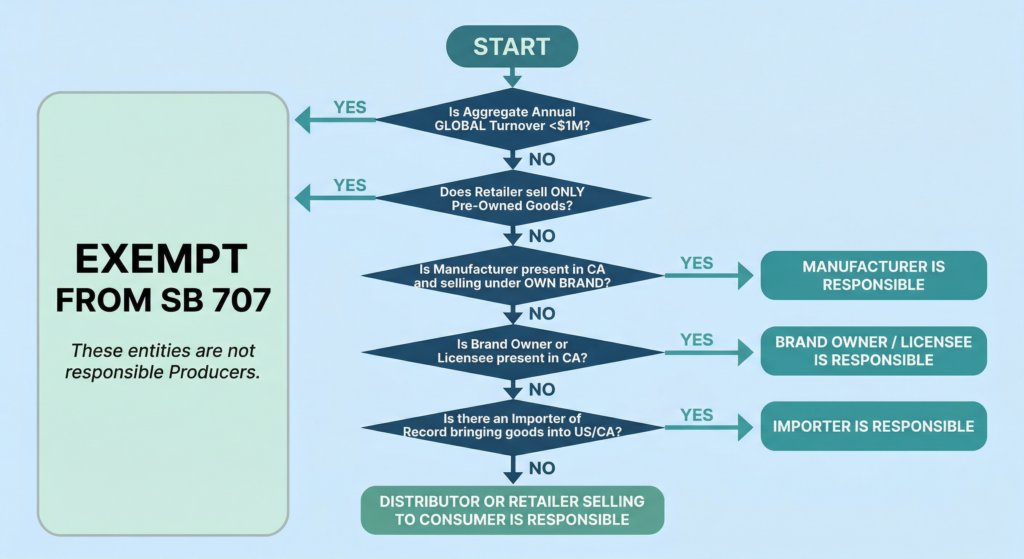
Exemptions (Section 42984.3(s)(7-8)):
- Small Producers: Producers with less than $1,000,000 in annual aggregate global turnover (adjusted for inflation) are exempt.
- Secondhand Sellers: Retailers selling only pre-owned goods (e.g., vintage stores) are exempt.
B. Covered Products (Inventory Audit Required)
You must audit your SKUs to determine liability.
- INCLUDED (Apparel): Undergarments, shirts, pants, dresses, suits, scarves, sportswear, swimwear, uniforms (school/work), footwear, handbags, backpacks.
- INCLUDED (Textile Articles): Blankets, curtains, towels, tapestries, bedding, tablecloths, napkins, pillows.
- EXCLUDED:
- Military Gear: Clothing items specifically for use by the United States Military are explicitly excluded.
- Protective Equipment (PPE): Equipment designed for industrial health/safety hazards.
- Single-use: Paper napkins, wipes.
- Carpets & Mattresses: Covered under separate CA stewardship laws.
- Medical: Reusable incontinence or menstruation products regulated by the FDA.
The PRO (Producer Responsibility Organisation)
The state (CalRecycle) does not manage the waste; the industry does. Producers must form and join a PRO (Section 42984.4).
The PRO’s Mandate
The PRO acts as the compliance arm for the industry. It is a 501(c)(3) non-profit that will:
- Collect Fees from brands.
- Manage Logistics: Organise the collection, transport, sorting, and recycling of waste.
- Submit the Plan: Design the comprehensive “Stewardship Plan” (due 12 months after regulations are finalised).
Critical 2026 Timeline:
- Jan 1, 2026 (PASSED): PRO applications were due to CalRecycle.
- March 1, 2026 (UPCOMING): CalRecycle must approve a PRO.
- July 1, 2026 (CRITICAL):
- All producers of covered products MUST join the approved PRO.
- They must register with the PRO and list all brands you sell.
- They must pay administrative fees immediately, and eco-modulated fees later (see below).
Financial Framework: “Eco-Modulated” Fees
This is the most significant business impact of SB 707. Instead of a flat tax, you will have to pay Eco-Modulated Fees (Section 42984.14).
While you must join the PRO in 2026 and pay administrative dues, the heavy Eco-Modulated Fees will likely not be invoiced until the Stewardship Plan is approved (approx. 2029). However, the design decisions you make today (Feb 2026) regarding your 2027/2028 collections will determine the fees you pay then.
How It Works (Bonus-Malus System)
The PRO must charge producers based on the net cost of managing their specific products.
- Malus (Penalty Fees): Charged on products that are difficult to recycle, contain hazardous chemicals (like PFAS), or consist of mixed-material blends (e.g., poly-cotton-elastane) that cannot be easily separated.
- Bonus (Reduced Fees): Incentives for products designed for durability, repairability, or containing high percentages of post-consumer recycled content.
Therefore, sourcing teams will have to calculate an end-of-life fee into the Landed Duty Paid (LDP) cost. A cheap, complex synthetic garment may become more expensive than a natural fiber garment once the PRO fee is applied.
Operational Requirements
A. The Collection Network (Convenience Standards)
The PRO is required to establish a massive physical collection network (Section 42984.10(d)).
- Convenience Metric:
- Urban: The PRO must provide at least 1 permanent collection site per 25,000 people (or 10 sites per county, whichever is greater).
- Rural: Specific minimums based on county population (e.g., 3 sites for small counties).
- Locations: These can be thrift stores, municipal centers, or retail locations.
- Retailer Impact: Retailers may volunteer to be collection sites. If you do, the PRO will provide containers, signage, and pick-up logistics at no cost to you.
B. The “Laundries” Provision (Microplastics)
Section 42984.10(l) requires the PRO to develop a programme to support industrial laundries.
- The goal is to reduce water consumption and improve the filtration of microfibers and microplastics.
- A portion of the fees collected from brands will be diverted to subsidise filtration technology for commercial cleaners and industrial laundry services.
C. Repair vs. Recycling
The law establishes a waste hierarchy where Reuse and Repair are prioritised over recycling.
- The PRO is authorised to contract with “Authorised Repair Businesses” (Section 42984.3(d)).
- Brands that offer free repair services or partner with authorised repairers may argue for lower fee obligations, as they are extending product life and delaying entry into the waste stream.
Technical Frameworks: IFRS S1 & S2 Integration
While SB 707 does not explicitly mandate IFRS compliance by name, treating them as separate projects is an operational mistake. SB 707 requires rigorous data reporting regarding material composition, end-of-life logistics, and financial costs. This aligns perfectly with global sustainability reporting standards.
What are IFRS S1 and S2?
The International Financial Reporting Standards (IFRS) issued by the ISSB (International Sustainability Standards Board) are the global baseline for disclosing sustainability risks to investors.
IFRS S1: General Sustainability-related Financial Disclosures
- Requires companies to disclose risks and opportunities that could affect their cash flow, access to finance, or cost of capital over the short, medium, and long term.
- The fees imposed by SB 707 represent a direct financial risk to your margins. Under IFRS S1, you must disclose how these regulatory costs impact your business model and what governance strategy you have to mitigate them (e.g., redesigning product lines to lower fees).
IFRS S2: Climate-related Disclosures
- Requires specific disclosure of climate risks and Greenhouse Gas (GHG) Emissions (Scope 1, 2, and 3).
- SB 707 Application:
- Scope 3 Emissions: Textile production and disposal are major contributors to Scope 3 (supply chain) emissions.
- The Connection: SB 707 prioritises repair and recycling. By extending the life of a garment (repair) or using recycled fibers (recycling), you reduce the need for virgin resource extraction. This lowers your Scope 3 emissions.
- Data Interoperability: The data you collect for the PRO (material volume, fiber type, recycling capability) is the exact same data required for accurate IFRS S2 reporting. Brands should integrate their PLM (Product Lifecycle Management) systems to feed both PRO compliance reports and IFRS disclosures simultaneously.
Specific Requirements for Online Marketplaces
The regulation places a specific burden on platforms (like Amazon, eBay, Poshmark, or specialised fashion marketplaces).
- You must notify the Department and the PRO of any Third-Party Seller who has sales of covered products over $1,000,000 in California in the preceding year.
- You must inform these third-party sellers of their legal requirements to join the PRO.
- You may be prohibited from allowing non-compliant producers to sell on your platform once the lists are finalised.
PFAS and Chemical Contamination
The law specifically targets PFAS (Per- and Polyfluoroalkyl Substances), often called “forever chemicals,” found in water-resistant gear and stain-resistant treatments.
- Needs Assessment (Section 42984.6(b)(2)(K)): The PRO has to evaluate the presence of PFAS in the waste stream.
- Products containing PFAS cannot be recycled into new textiles in many cases.
- Expect the highest tier of “Malus” fees for products containing PFAS, as they contaminate the recycling stream and limit end-markets.
Enforcement and Penalties (Starting 2030)
While 2030 seems far away, the infrastructure must be built now.
- Civil Penalties (Section 42984.21):
- $10,000 per day for general violations.
- $50,000 per day for intentional or knowing violations.
- The Retail Sales Ban (Section 42984.20(c)(2)): Enforcement goes far beyond public shaming. CalRecycle will maintain an official website of compliant producers. If you fall out of compliance, retailers, distributors, and online marketplaces are legally prohibited from selling, offering for sale, or importing your covered products into the state. Non-compliance effectively freezes your California inventory.
Practical Action Plan: What to Do Right Now (Feb 2026)
- Check Your Status: Verify if your California turnover exceeds $1M. If yes, you are a Producer.
- Monitor PRO Approval (March 2026): Watch for CalRecycle’s announcement of the approved PRO.
- Budget for July 2026: Prepare to pay the initial administrative fees required to join the PRO by the July 1st deadline.
- Inventory Audit: Classify your product lines by fiber type (Cotton, Poly, Blends). Identify “problem products” (mixed fibers, PFAS, permanent hardware) that will trigger high fees.
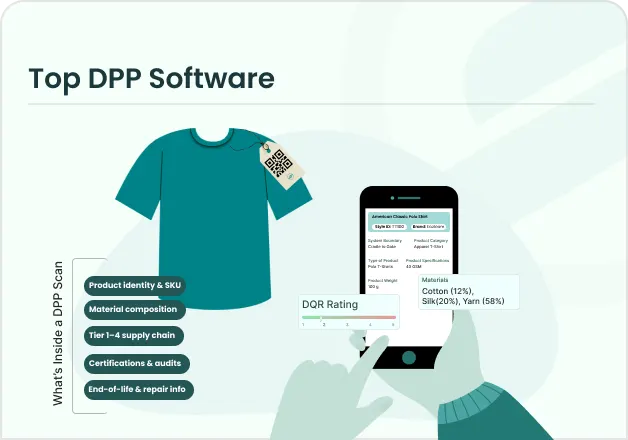
- Digital Tagging (Best Practice): Begin exploring Digital Product Passports (DPP). While California has not strictly mandated DPP technology (unlike upcoming EU regulations), the PRO and downstream recyclers will require granular, SKU-level material data to assess your fees. DPPs are rapidly becoming the most efficient way to prove fiber composition and secure lower “Bonus” Eco-Modulated fees.
- Data Integration: Ensure your sustainability team (handling IFRS) and your sourcing team (handling SB 707) are using the same data sets.
The cheapest way to comply is to design products that are durable, repairable, and mono-material.
2026–2030 Roadmap:
| Date / Phase | Milestone | What It Means for Industry | Operational / Financial Impact |
| Jan 1, 2026 (Passed) | Deadline for PRO applications submitted to CalRecycle | Industry organisations applied to become the official compliance body | Monitoring phase — no direct action required but governance tracking recommended |
| March 1, 2026 (Upcoming) | CalRecycle approves or rejects PRO application | Official PRO selected | Begin readiness planning for mandatory participation |
| July 1, 2026 (Action Required) | Mandatory PRO Joinder Deadline | All obligated producers must join the approved PRO | Payment of initial administrative/startup fees; budgeting required |
| Late 2026 → Early 2027 | Data collection for assessment | PRO gathers producer data (sales volumes, material composition) | Data infrastructure readiness; PLM/ERP integration needed |
| March 1, 2027 (Data Heavy) | Statewide Needs Assessment submission | PRO evaluates waste stream and infrastructure needs | Reporting workload; SKU-level material data disclosure |
| July 1, 2028 | programme regulations formally take effect | Operational framework becomes enforceable | Compliance processes must be fully embedded |
| ~July 2029 | Stewardship Plan approval (incl. fee schedule) | Final eco-modulated fee structure determined | Direct cost modeling and product design implications |
| July 1, 2030 (or upon approval of a plan, whichever is sooner) | Full Enforcement Begins | Civil penalties applicable | $10K–$50K/day risk; market access restrictions |