Within California’s SB 707 framework, the Stewardship Plan is the single most important document of the entire textile Extended Producer Responsibility (EPR) system.
It is the “Master Operations Manual” for the textile recycling industry in California, a legally binding document that the Producer Responsibility Organisation (PRO) must write and submit to CalRecycle for approval.
As of March 2026, the initial PRO approval deadline has passed, shifting the industry from the formation phase into the planning phase, with the first major milestone being the Needs Assessment due in March 2027, which will generate the data required to design the Plan.
Once approved, the Stewardship Plan will become the rulebook that governs financial obligations, material definitions, recyclability criteria, and system logistics. For brands selling into California, its implications will extend far beyond waste management and will influence product design, sourcing strategies, cost structures, and long-term margin planning.
The following section breaks down the Stewardship Plan’s core purpose and mandatory components based directly on Section 42984.10 of the statute, outlining why understanding its structure is critical for strategic readiness in the future.
Based on California Senate Bill 707 (Chapter 864), the Stewardship Plan is the single most important document in this entire legal framework.
The Core Purpose
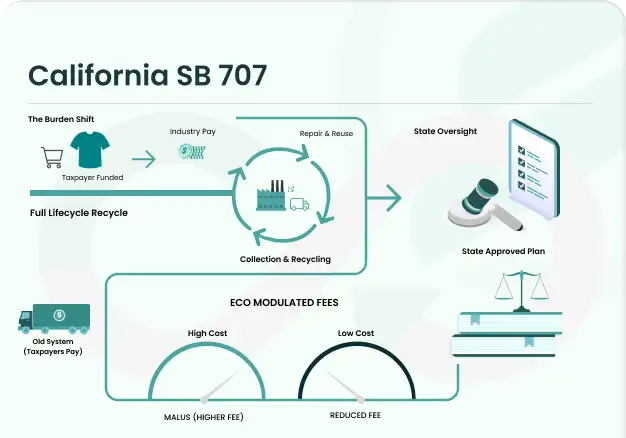
The State of California is not building recycling plants or driving trucks to pick up old clothes. The Stewardship Plan is the document where the industry (the PRO) tells the State how it is planning to collect, transport, sort, and recycle millions of tons of textiles, and exactly how the industry will pay for it.
If the Plan is approved, it becomes the rules of the road. If it is rejected, the PRO cannot operate, and producers face penalties.
Mandatory Components of the Plan
According to the law, the Plan should contain specific, actionable details in the following areas:
A. The Financial Mechanism (Eco-Modulated Fees)
The Plan should reveal the formula for how much brands will be charged. It must include:
- A 5-year budget covering all administrative, operational, and capital costs.
- Details of the Eco-Modulated Fees. This is where the Plan defines the “Malus” (penalty) for hard-to-recycle items (like mixed-blend fabrics or items with hazardous chemicals) and the “Bonus” (discount) for durable or recyclable items.
- Reserves: The Plan must show the PRO has enough cash in the bank to run for 6 months without new income (the PRO has until the end of year two of operations to fully fund this reserve).
B. The Physical Collection Network
The Plan must map out the physical locations where consumers can drop off clothes. It demands specific convenience standards:
- Urban Areas: At least one permanent collection site per 25,000 people.
- Rural Areas: Specific minimums based on county population (e.g., at least 3 sites for counties with under 18,000 people).
- Types: The Plan will identify if these are bins in mall parking lots, thrift stores, or municipal waste centers.
C. The “Chain of Custody” (Sorting & Logistics)
The Plan must detail exactly what happens to a garment after it is dropped in a bin. This is important for brands concerned about brand protection (i.e., avoiding your products ending up in a burning landfill in the Global South).
- It must identify “Authorised Sorters” and “Authorised Repair Businesses.”
- The Plan must prove it prioritises Reuse and Repair over Recycling. Recycling is a lower priority than keeping the item in use as clothing.
- The Plan must describe how they will track materials to ensure they actually reach a responsible end market and aren’t dumped overseas.
D. Managing “Forever Chemicals” (PFAS)
This is an aggressive part of the law. The Plan must explicitly state how the PRO will deal with PFAS (per- and polyfluoroalkyl substances).
- The Problem: Rain jackets and stain-resistant pants often contain PFAS. These chemicals can contaminate a recycling batch, making the resulting recycled yarn toxic/unusable.
- The Plan’s Role: The PRO must outline investments in technology to detect and separate PFAS-contaminated textiles so they don’t ruin the recycling stream.
E. The “Laundry” Provision (Microplastics)
The Plan must include a programme to support industrial laundries.
- The goal is to reduce water consumption and improve filtration of microfibers and microplastics during the washing process.
- This means the PRO might use brand fees to subsidise better filtration systems for commercial laundry partners.
F. Education and Outreach
The Plan must show how the PRO will retrain 39 million Californians.
- It requires a comprehensive marketing strategy to teach consumers not to throw clothes in the trash bin, but to use the new PRO collection network.
- It must verify that materials are available in multiple languages and address diverse communities.
The “Needs Assessment” Precursor
Before the PRO can write the Stewardship Plan, they must complete a Needs Assessment (Section 42984.6).
- Due Date: March 1, 2027.
- Function: This is a massive research project to determine: “How many tons of polyester vs. cotton are currently entering CA landfills?” and “How many recycling plants do we actually have?”
- Impact: The data from the Needs Assessment dictates the targets and budgets in the Stewardship Plan.
Why This Matters to a Fashion Brand
You might think, “The PRO writes this, why do I care?”
You care because the Stewardship Plan determines your invoice.
- If the Plan budgets for expensive chemical recycling plants to handle polyester blends, your fees for polyester products will go up.
- If the Plan sets strict durability standards to qualify for “Reuse,” your sourcing team needs to know those standards now to adjust fabric quality for 2027/2028 collections.
- The Plan will define what counts as “Recyclable” in California. If your design doesn’t meet the Plan’s definition, you will end up paying the highest penalty fees.