
As of January 1, 2026, the final phase of the UK Government’s timeline for sustainability reporting has largely taken effect. For the fashion and textile industry, a sector historically plagued by vague “eco-friendly” claims and opaque supply chains, the Sustainability Disclosure Requirements (SDR) is part of the larger change being brought about by regulatory bodies across the world.
While the SDR was authored by the Financial Conduct Authority (FCA) primarily for the financial sector, its grip has tightened around the “Real Economy”, the brands making and selling clothes. If you want access to capital, or if you want to market your Spring/Summer 2026 collection without facing fines, you must understand this framework.
What is the SDR?
The Sustainability Disclosure Requirements (SDR) is a regulatory framework designed to ensure that investors and consumers have trust in sustainability claims.
SDR is an “anti-confusion” law. Before SDR, a fashion brand could claim a dress was “sustainable” because it used 5% recycled polyester, and an investment fund could call itself “green” while investing in fast fashion giants with no transition plans.
The SDR changes this by enforcing two main mechanisms:
- For Money (Investment Labels): Strict criteria for investment funds. If a fund wants to be labeled “sustainable,” it can only invest in brands that provide rigorous data proving they are sustainable.
- For Marketing (Anti-Greenwashing Rule): A blanket ban on misleading sustainability claims for all FCA-authorised firms, which sets the standard for the wider market.
Impact on Fashion
Fashion relies heavily on Scope 3 data (supply chain emissions) and consumer marketing. The SDR forces companies to move from storytelling (e.g. photos of happy cotton farmers) to reporting (e.g. audited water usage data from Tier 2 dye houses).
The Anti-Greenwashing Rule Impacts Marketing
Effective since: May 31, 2024
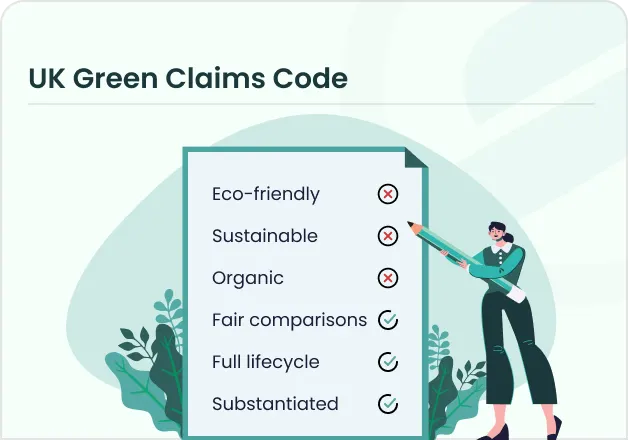
Although this rule technically applies to FCA-authorised firms (investors/insurers), it has created a trickle-down legal standard that works in tandem with the Competition and Markets Authority (CMA) Green Claims Code.
The core principle here is that sustainability claims must be fair, clear, and not misleading.
Practical Application for 2026 Fashion Marketing
By now, your marketing team should have retired vague terminology. Here is how the rule applies to a standard fashion campaign:
| The Old Way (Non-Compliant) | The 2026 Compliant Way | Why? |
| “Our Sustainable Collection” | “Collection made with 85% GOTS-Certified Organic Cotton.” | “Sustainable” is an absolute term that is impossible to prove. Specific material attributes are verifiable. |
| “Green” or “Eco-Friendly” | “Uses 40% less water than conventional denim.” | Claims must be comparative and backed by data. “Eco-friendly” implies zero harm, which is misleading. |
| A picture of a green leaf on a tag | A QR Code linking to a Digital Product Passport (DPP). | Visual imagery that implies environmental benefit without context is considered a misleading “implied claim.” |
If your brand relies on green claims to sell products, you are now liable to provide the evidence backing those claims to your investors (to satisfy SDR) and to regulators (to satisfy the CMA).
Investment Labels: How Investors See Your Brand
One of the most critical aspects of the SDR is the Investment Labels regime. Asset managers (the people who invest in your company) can now only use specific labels on their funds.
To get your fashion brand included in these funds, you must provide data that fits one of these four categories. If you cannot provide the data, capital may dry up.
A. Sustainability Impact
- Who fits here: Circular economy startups, textile-to-textile recycling plants, or biotech firms creating lab-grown leather.
- Requirement: You must demonstrate a measurable, positive contribution to a specific environmental or social problem.
B. Sustainability Focus
- Who fits here: Established “Eco” brands (e.g., Patagonia-tier) where at least 70% of assets meet a robust standard of sustainability.
- Requirement: Rigorous evidence of supply chain integrity (e.g., 100% certified organic or regenerative fibers).
C. Sustainability Improvers
- Who fits here: Mainstream retailers and high-volume brands that are not currently sustainable but are transitioning.
- Opportunity: This is the most important label for the mass market. It allows investors to back high-emitting fashion brands IF those brands have a credible, funded, and time-bound plan to reach Net Zero.
- Requirement: You must disclose your Transition Plan (aligned with the Transition Plan Taskforce – TPT).
D. Sustainability Mixed Goals
- Who fits here: Brands in diversified portfolios where sustainability is one of several factors.
The Data Reporting Landscape (2026 Update)
According to the Government’s implementation timeline (updated May 2024), we have now passed several critical milestones.
UK Sustainability Reporting Standards (UK SRS)
- As of Q1 2025, the UK Government endorsed the ISSB Standards (IFRS S1 & S2) to create the UK SRS.
What Textile Brands Must Report in 2026:
Under these standards, fashion brands are expected to disclose:
- Governance: How does your Board oversee climate risks? (e.g., Do you have a Chief Sustainability Officer with veto power?)
- Strategy: How do climate risks (e.g., flooding in Bangladesh, drought in cotton-growing regions) affect your business model?
- Risk Management: How do you identify forced labor or chemical pollution risks in your supply chain?
- Metrics & Targets:
- Scope 1 & 2: Emissions from your own offices and warehouses (easy).
- Scope 3: Emissions from fabric production, dyeing, tanning, and transportation. This is mandatory under IFRS S2.
For a fashion brand, Scope 3 often accounts for 90%+ of total emissions. You cannot comply with SDR without primary data from your suppliers.
Transition Plans
By now (Feb 2026), the FCA has strengthened expectations for transition plan disclosures.
For a fashion brand to qualify as an “Improver” to investors, your Transition Plan must include:
- Concrete Decarbonisation Levers: “We will switch 50% of our polyester to textile-to-textile recycled inputs by 2028.”
- Financial Planning: “We have allocated £10M CAPEX to retrofit our key supplier’s dye house.”
- Nature-Related Disclosures: (Based on TNFD – Taskforce on Nature-related Financial Disclosures). You must address biodiversity risks, such as water pollution from leather tanning or soil degradation from cotton farming.
Strategic Checklist for Fashion Executives
If you are a leader in the textile sector, here is your immediate action plan:
- Audit Your “Improver” Narrative: If you are not a sustainability focus brand, ensure your transition plan is robust enough to qualify for “Improver” capital. If your plan lacks interim targets (e.g., 2028 goals), you are uninvestable to SDR-labeled funds.
- Scope 3 Data Hygiene: Stop using industry averages (Higg Index secondary data) where possible. Move toward primary data collection (utility bills from factories) to satisfy the IFRS S2 rigorous requirements.
- The Green Hushing Balance: Do not stop marketing sustainability (Green Hushing) out of fear of the Anti-Greenwashing rule. Instead, market precision. Replace adjectives with nouns and numbers.
- Prepare for the Green Taxonomy: As noted in the 2024 update, the UK Government is developing a Green Taxonomy (a dictionary of what counts as sustainable). Expect this to define sustainable textiles strictly (likely requiring durability and recyclability criteria) in the near future.
Glossary of Terms
- FCA (Financial Conduct Authority): The UK regulator for financial services. They wrote the SDR.
- ISSB (International Sustainability Standards Board): The global body that wrote IFRS S1 and S2 – the accounting standards for carbon.
- Scope 3: Indirect emissions that occur in a company’s value chain (e.g., the emissions from the factory making your zippers).
- TPT (Transition Plan Taskforce): The framework for how companies show they are moving from dirty to clean.
- Greenwashing: Making exaggerated, misleading, or unsubstantiated claims about the environmental benefits of a product or service.