
Italy has moved from considering fashion as a culturally protected sector operating above environmental consequence to now placing fashion inside the same regulatory frame as energy, waste, and heavy industry. With DDL S.1690, the Italian Senate restructures who gets to advertise, who pays more tax, who qualifies for incentives, and who faces market friction based on how fashion products are designed, produced, distributed, and discarded.
At the center of the proposal sits the Sistema Nazionale di Eco-Score Tessile (SNET).
What is Italy’s Eco-Score (SNET)?
Italy’s proposed Sistema Nazionale di Eco-Score Tessile (SNET) is a mandatory A–E rating system for fashion products entering the Italian market. Defined in Senate Bill S. 1690, it targets “ultra-fast fashion” by imposing advertising bans, environmental waste fees, and strict customs barriers on products scoring D or E based on their environmental impact, circularity, and supply chain transparency.
Why fashion is singled out
Fashion, as defined in the bill, is identified as a major source of environmental pressure, a contributor to resource depletion and microplastic dispersion, a sector tied to labor exploitation, including child labor in non-EU supply chains, and a driver of industrial decline inside Italy since the 1990s.
The Senate anchors its intervention in specific data:
- Italy generated approximately 480,000 tonnes of textile waste in 2019.
- 5–6% of unsorted municipal waste consists of textiles, amounting to over 660,000 tonnes annually destined for landfill or incineration.
- The textile sector accounts for around 10% of global greenhouse gas emissions.
Taken together, these figures form the justification for regulatory intervention into fashion business models and products.
Who is in scope (and who is targeted)
The bill explicitly aims to curb “Ultra-Fast Fashion,” but the legal definitions act as a dragnet that can catch any brand lacking data transparency.
Fast-renewal fashion
Defined as industrial and commercial practices aimed at placing a high number of new garments on the market in extremely short timeframes, encouraging compulsive consumption and rapid product replacement.
The “Ultra-Fast Fashion” Definition (Art. 2)
Your brand or product line risks being classified as “Ultra-Fast Fashion” (and subject to the harshest penalties) if you meet criteria such as:
- High Volume: Releasing more than 5,000 new references (SKUs) per month.
- Speed: No seasonal collections; product rotation is faster than 30 days.
- Material: Prevalent use of synthetic materials that are difficult to recycle.
- Score: Falling into Class D or E of the SNET due to a lack of traceability.
Who is exempt?
The bill differentiates low price from “ultra-fast” operations. Brands that operate with standard seasonal calendars, utilise natural or recyclable materials, and maintain supply chain traceability to prove an A, B, or C score, are exempt from the punitive measures.
How SNET Scoring Works (The A–E Scale)
The Ministry of Environment and Energy Security (MASE) will oversee the scoring system. To achieve a score of A, B, or C, brands must provide data on the following parameters:
- Production Conditions & Locations: Where the item was made and the energy mix used.
- Materials: Provenance, quality, and composition (natural vs. synthetic).
- Logistics: The environmental cost of distribution (air freight vs. sea/rail).
- Durability & Reparability: Technical lifespan of the garment and availability of repair services.
- Social Compliance: Adherence to labor standards in the supply chain.
The “Pre-Qualification” Fast Path
The bill also introduces a mechanism for environmental pre-qualification. Companies that can may access advance favourable classification in the A-C range if they demonstrate:
- production traceability systems,
- recognised environmental and social certifications,
- compliance with Extended Producer Responsibility (EPR),
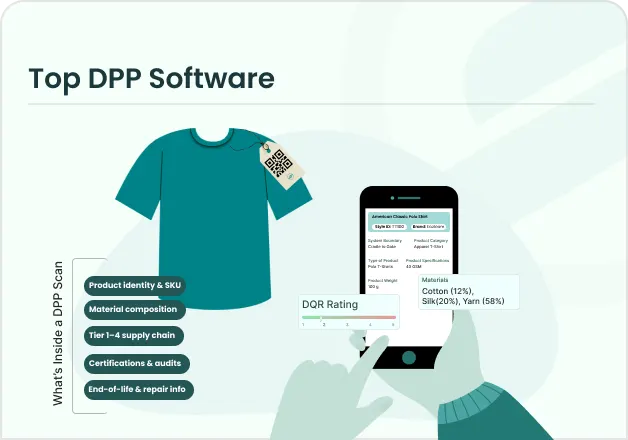
- adoption of the Digital Product Passport (DPP) where required.
What happens if you score D or E?
If your products fall into Class D or E (or if you fail to provide data, defaulting you to the bottom), the consequences are severe:
1. Total Advertising Ban (Art. 5)
- The Rule: A total prohibition on advertising, direct or indirect, for brands or products classified as “Ultra-Fast Fashion” (Class D/E).
- Scope: The ban applies to all media channels, digital platforms, influencers, content creators, and any subject contributing, even indirectly or through paid collaboration.
- Timing: The bill text proposes this ban starts January 1, 2026.
2. Waste Management Fees (EPR) (Art. 6)
Producers must pay an “anticipatory contribution” for waste management:
- Class D: €0.30 per kilogram.
- Class E: €0.50 per kilogram.
The contribution applies to domestic producers, importers, distributors, digital platforms, and non-EU sellers.
It will be mandatory for Non-Italian operators to appoint a fiscal representative in Italy, who becomes jointly responsible for compliance. This provision places environmental cost directly onto product weight and classification, rather than revenue or profit.
3. The “Parcel Tax” (Art. 9)
To close the loophole of direct-from-China shipping, an “ecological tax” applies to small parcels (under 2kg) containing textiles from non-EU countries:
- Cost: Between €2.00 and €4.00 per package.
4. Overproduction loses its fiscal escape (Art. 7)
Access to tax benefits linked to the donation of unsold goods for operators adopting fast-renewal models will be removed
The restriction applies only to operators or products classified under categories D or E. Companies can be exempt if they can demonstrate compliance with EU traceability, EPR, and certification requirements.
Implementation Playbook: A 90-Day Plan
If you sell fashion and textile products in Italy, you should start working on your compliance strategy for S-Net. Here is a 90-day compliance roadmap.
Day 0–30: Baseline & Risk Assessment
- SKU Analysis: Identify how many SKUs you launch monthly. Are you near the 5,000 threshold?
- Map Suppliers: Identify Tier 1 and Tier 2 suppliers for your top-selling categories.
- Assign Ownership: Establish a RACI chart (see below).
Day 31–60: Data Readiness
- Simulate Scoring: Using the criteria in Art. 3, audit your current Spring/Summer collection. Would it score D or E due to missing data?
- Supplier Outreach: Launch data requests for traceability evidence (Certifications, Energy usage).
- Logistics Review: Flag non-EU direct-to-consumer shipments <2kg that will attract the new tax.
Day 61–90: Operationalise
- Marketing Gating: Implement a “SNET Check” before approving ad spend for Q1 2026.
- E-Commerce Updates: Prepare product detail pages (PDPs) to display environmental warnings if required.
Compliance RACI
| Task | Responsible | Accountable | Consulted | Informed |
| SNET Calculation | Sustainability | Head of Product | Sourcing | Marketing |
| Ad Ban Compliance | Marketing | CMO | Legal | E-comm |
| EPR Fee Budgeting | Finance | CFO | Supply Chain | Logistics |
| Supplier Data | Sourcing | COO | Sustainability | IT |
SNET Data Dictionary
To avoid a default “Class E” rating, ensure your PLM (Product Lifecycle Management) system can export the following fields per SKU:
- Material Composition: % Synthetic vs. Natural vs. Recycled.
- Recyclability: Is the blend separable? (Yes/No).
- Origin – Raw Material: Country of origin for fiber.
- Origin – Assembly: Country of cut-and-sew.
- Logistics Mode: Air / Sea / Road / Rail.
- Social Audit: Certification ID (e.g., SA8000, WRAP) for the assembly factory.
- Durability: Result of pilling/abrasion tests
- Repair: Is a repair service or kit offered? (Yes/No).
Article-by-Article Structure and Commercial Impact DDL S.1690
| Article | Provision | What it Regulates | Practical Meaning for Fashion & Textile Operators |
| Art. 1 | Principles and objectives | Scope and intent of the law | Establishes fashion as an environmental and industrial system subject to corrective regulation, not voluntary sustainability |
| Art. 2 | Definitions and scope | Legal definitions of fast-renewal and ultra-fast fashion | Introduces velocity, SKU volume, lack of seasonality, and disposability as legally relevant business traits |
| Art. 3 | National Textile Eco-Score (SNET) | Environmental classification A–E | Eco-Score becomes a gatekeeper for advertising, incentives, fiscal exposure, and distribution access |
| Art. 4 | Digital information obligations | Online sales transparency requirements | Country of manufacture and responsible-consumption messaging must be shown next to price for D/E products |
| Art. 5 | Advertising and promotion ban | Marketing and influencer activity | Advertising rights become conditional on Eco-Score and production conduct |
| Art. 6 | Extended Producer Responsibility and environmental contribution | Interim EPR and product-based fees | Environmental cost attaches to product weight and classification, not revenue |
| Art. 7 | Tax benefits for unsold goods | Donation of overstock | Overproduction followed by donation no longer grants fiscal neutrality for D/E models |
| Art. 8 | Customs and traceability | Import controls and burden of proof | Signals future tightening of non-EU textile imports, especially digital commerce |
| Art. 9 | Ecological parcel tax | Logistics and cross-border shipping | High-frequency, low-value shipping models become fiscally exposed |
| Art. 10 | Entry into force | Implementation timeline | Law activates 60 days after publication, with staggered decrees |
Key Dates and Regulatory Milestones
| Date / Deadline | Event | Legal Reference | What Changes Operationally |
| 23 Oct 2025 | Bill presented to the Senate | Legislative record | Formal start of regulatory process targeting fast and ultra-fast fashion |
| 11 Nov 2025 | Assigned to Senate committees | Parliamentary procedure | Technical and political scrutiny begins |
| Publication in Gazzetta Ufficiale | Law officially published | Art. 10 | Starts countdown to legal enforceability |
| +60 days from publication | Law enters into force | Art. 10 | Core obligations become legally binding |
| Within 60 days of entry into force | Decree setting parcel tax (€2–€4) | Art. 9 | Cross-border textile logistics become taxable |
| Within 60 days of entry into force | Decree on tax-benefit verification for donations | Art. 7 | Donation-based tax strategies reviewed against Eco-Score |
| Within 90 days of entry into force | Decree defining SNET scoring methodology | Art. 3 | Eco-Score becomes operational and enforceable |
| Within 90 days of entry into force | Decree on digital information obligations | Art. 4 | Online fashion retail must adjust UX and disclosures |
| Within 90 days of entry into force | Decree on environmental contribution mechanics | Art. 6 | Interim EPR fees activated for D/E products |
| Within 6 months of entry into force | Government report on customs traceability | Art. 8 | Prepares tightening of non-EU import controls |
| 1 January 2026 | Advertising ban applies | Art. 5 | Fast-renewal and ultra-fast fashion lose promotional visibility |
FAQs about Italy’s Eco-Score
Is SNET already a law?
It is currently a bill (DDL S. 1690) in the Senate. However, the text proposes effective dates as early as January 2026, implying an urgent legislative track.
Does this apply to footwear and accessories?
Yes. The bill references “clothing, footwear, and accessories” (Art. 2) within the context of fast fashion.
Can influencers still promote fast fashion?
No. Under Art. 5, promoting products/brands classified as “ultra-fast fashion” (Class D/E) is prohibited. Violations attract administrative fines up to €100,000.
What is the “Shein Tax”?
This refers to Article 9 of the bill, which imposes a specific ecological tax (€2–4) on small parcels (<2kg) of textiles entering Italy from non-EU countries, targeting direct-to-consumer platforms.
How does SNET relate to the EU Digital Product Passport (DPP)?
SNET is aligned with the DPP. Article 2 explicitly states that possession of a Digital Product Passport is a criteria for avoiding the “ultra-fast fashion” classification. Data collected for SNET will likely satisfy future EU DPP requirements.