
Carbon has entered your balance sheet.
From 1 January 2026, the European Union has begun treating carbon emissions embedded in imported goods as a direct financial liability. The Carbon Border Adjustment Mechanism (CBAM) moves carbon from voluntary sustainability disclosures into binding customs law.
For fashion brands and textile manufacturers, this marks a structural shift in how machinery, materials, and soon fabrics enter the European market.
If you place products in the EU, carbon data now determines cost, access, and risk, even if your factories sit outside Europe. CBAM attaches a carbon price to imports that mirrors the cost paid by European manufacturers under the EU Emissions Trading System (ETS). The objective is to provide parity where imported goods carry the same carbon cost as goods produced inside the Union.
Why the EU Introduced CBAM
CBAM was designed to address carbon leakage.
Carbon leakage occurs when production shifts from regions with strict climate regulation to regions with weaker or no carbon constraints. It also occurs when high-emission imports displace lower-emission European products, undermining EU climate policy.
For example, an EU steel producer pays for every tonne of CO₂ emitted under the ETS. To avoid these rising costs, production relocates to a non-EU country with no carbon price. The steel is then exported back into the EU at a lower price.
Global emissions stay the same or rise while EU climate rules lose effectiveness. This is carbon leakage through relocation.
CBAM closes this gap by making sure that importers buy CBAM certificates reflecting the embedded emissions of their goods. Certificate prices follow the ETS allowance price, ensuring cost parity between EU and non-EU producers.
Rather than looking at CBAM as a tariff, you can say that it is a climate adjustment linked directly to verified emissions data. The better your carbon performance, the lower your cost.
The Legal Foundation
CBAM is anchored in Regulation (EU) 2023/956, which entered into force in May 2023. Its application was designed to be phased.
Multiple implementing regulations now sit beneath this framework. These define:
- registration requirements
- emissions calculation methodologies
- reporting formats
- verification rules
- enforcement mechanisms
In October 2025, the EU adopted Regulation (EU) 2025/2083, adjusting thresholds, timelines, and administrative provisions. In December 2025, the Commission released proposals to:
- expand CBAM to downstream goods
- strengthen anti-circumvention enforcement
Together, these acts form a binding customs regime, not a voluntary disclosure system.
The CBAM Timeline
CBAM operates in three stages.
| Stage | Period | Key Obligations | Financial Impact |
| Stage 1: Transitional Phase | 1 Oct 2023 – 31 Dec 2025 | Quarterly reporting of embedded emissions Learn reporting systems and data collection | No payment required Penalties already issued for errors |
| Stage 2: Definitive Phase | From 1 Jan 2026 | Mandatory reporting and surrender of CBAM certificates One certificate per tonne of CO₂ | Carbon cost begins Liability accrues from 2026 |
| Stage 3: Full Integration | 2026 – 2034 | Phase-out of free ETS allowances for EU producers | CBAM costs increase progressively |
Indirect Impact on Fashion Through Metal Hardware
CBAM currently applies only to goods listed in Annex I of the regulation. Finished garments and fabrics are excluded. However, fashion supply chains rely heavily on metal components that may fall squarely within CBAM scope.
According to the Combined Nomenclature (CN Codes) used by EU Customs:
- Buttons are classified under CN 9606.
- Zippers are classified under CN 9607.
- Buckles, Hooks, Eyelets for clothing are classified under CN 8308.
None of these three chapters (96 and 83) are listed in Annex I of the CBAM Regulation. Therefore, standard zippers, buttons, and buckles are EXEMPT from CBAM, even if imported loosely.
What IS included (The Nuance):
CBAM applies to generic industrial hardware that a fashion brand might use for heavy-duty applications, displays, or non-standard trims that customs does not recognize as “clothing accessories.”
Included: Industrial rivets (CN 7318), standard screws (CN 7318), generic chains (CN 7315), or generic metal tags/plates (CN 7326/7616).
In these cases, the EU importer becomes responsible for:
- authorised CBAM declarant registration
- emissions reporting
- surrendering CBAM certificates
A volume-based exemption applies if total CBAM-covered imports remain below 50 tonnes per year.
The Real Risk for Fashion Lies in CBAM’s Expansion
For fashion, the critical issue is not what CBAM covers today, but rather what it is designed to cover next.
CBAM is explicitly structured as a scalable mechanism. The Commission has stated that the current scope is only the first step. By 2030, the EU intends to extend CBAM to chemicals and polymers, directly targeting the backbone of modern fashion supply chains:
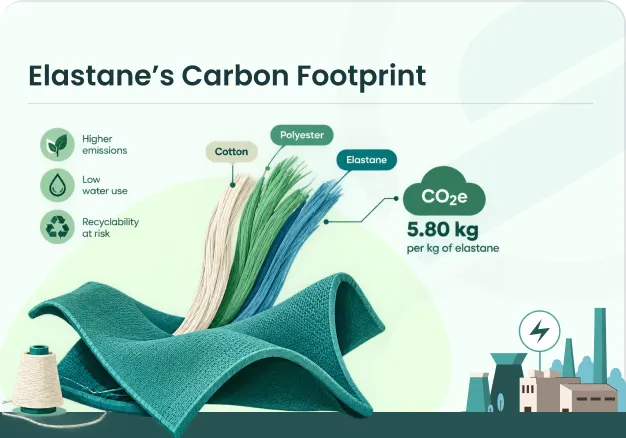
Polyester. Nylon. Acrylic. Elastane.
These fibres originate from energy-intensive chemical processes with high carbon intensity and limited upstream transparency. Once polymers enter scope, each kilogram of synthetic fibre will require a verified carbon declaration.
Where brands lack access to primary supplier data, default values apply. These defaults are intentionally conservative and often reflect the highest emissions intensity observed in the producer country. For many brands, this converts data opacity into immediate cost inflation.
Closing Loopholes: Scrap and Circumvention
The December 2025 Commission proposal closes several pathways that previously allowed emissions to escape accounting.
One key change concerns metal scrap. Pre-consumer steel and aluminium scrap previously carried zero embedded emissions in many cases. This treatment is ending. Scrap may now be treated as a covered precursor, with emissions allocated to its production.
In parallel, anti-circumvention enforcement has tightened. Artificial supply-chain restructuring, minor processing steps introduced solely to avoid CBAM, now triggers scrutiny. Customs authorities may:
- demand additional documentation
- suspend simplified procedures
CBAM is enforced as customs law. Flexibility ends where abuse begins.
Non-Compliance Is a Market Access Risk
CBAM carries direct enforcement consequences.
Failure to surrender sufficient CBAM certificates results in a penalty of €100 per excess tonne of CO₂, indexed to inflation. Repeated violations lead to withdrawal of authorised CBAM declarant status. Without this authorisation, imports cannot proceed.
What Compliance Looks Like in Practice
Importers must first obtain authorised CBAM declarant status, demonstrating:
- financial capacity
- operational stability
- clean compliance history
Applications require:
- EORI details
- legal entity information
- three years of financial statements
- declarations of honour confirming absence of serious violations
Once authorised, flexibility ends.
Importers must submit installation-level emissions data from the specific production facility. Regional averages and generic benchmarks no longer apply.
Required calculations include direct process emissions and indirect emissions from electricity use (for selected sectors).
In addition to this, all CBAM data must be verified by accredited independent verifiers. Early years often involve physical site visits. Later audits may be virtual under strict conditions.
The EU operates:
- a central CBAM Registry for importers
- the Operators of Third Country Installations (O3CI) portal for non-EU manufacturers.
Suppliers upload verified data once. Multiple EU buyers can reference the same dataset, reducing duplication and risk.
How Carbon Pricing Works
CBAM certificates have no fixed price.
Prices track the EU ETS allowance market:
- 2026: quarterly average ETS price
- from 2027: weekly average
Certificates are sold through a central Commission-managed platform.
If a supplier has already paid a carbon tax or ETS cost locally, that amount can be deducted, with proof of payment. Detailed deduction rules are expected in early 2026.
What Fashion Brands Should Do Now
CBAM already influences sourcing decisions.
Brands should:
- map CN codes across machinery, components, and materials
- assess import volumes against exemption thresholds
- audit suppliers for installation-level data availability
- support O3CI registration
- update contracts to mandate CBAM data delivery and audit rights
- track EU ETS prices for cost forecasting
Preparation today reduces your cost tomorrow.
Summary Table for the Fashion Industry
| Item | Status | CBAM Impact |
| Cotton T-Shirt | Excluded | None currently |
| Polyester Dress | Excluded | High future risk (polymers under review, Article 30) |
| Leather Shoes | Excluded | None currently |
| Standard Zippers/Buttons loose (CN 96) | Excluded | Excluded (Chapter 96 not in Annex I) |
| Generic Rivets/Fasteners Loose (for example CN 7318) | Included | CBAM applies (Must report if >50 tonnes). |
| Aluminium Packaging Loose (for example CN7612) | Included | CBAM applies (Must report if >50 tonnes). |